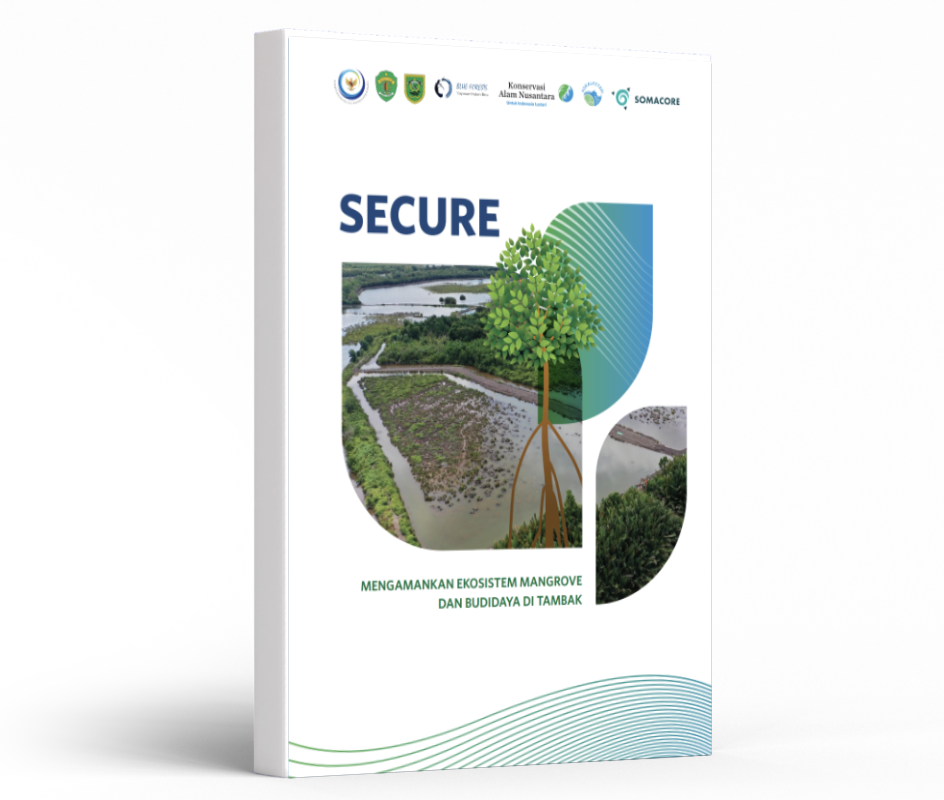
SECURE: Securing Mangrove Ecosystems and Aquacultute in POnds for a Sustainable Indonesia
CTC-CFF Thematic Alignment
- Community-Based Coastal Resource Management (CBCRM)
- Ecosystems Approach to Fisheries Management (EAFM)
Geographic Scope
- Indonesia
Content Language(s)
- Bahasa Indonesia
Introduction/Context
Overview:
The SECURE (Shrimp Carbon Aquaculture) program is an innovative eco-friendly aquaculture initiative developed through collaboration between Yayasan Konservasi Alam Nusantara (YKAN), Blue Forests, and the local government of Berau Regency, East Kalimantan. Designed to address the severe environmental degradation caused by conventional land conversion, the project harmoniously integrates sustainable brackish-water shrimp and milkfish farming with active mangrove ecosystem conservation. The program operates by re-designing traditional ponds into smaller, hyper-efficient cultivation plots while dedicating the remaining land—often up to 50% to 80%—to community-based hydrological restoration and natural mangrove regeneration. By entirely eliminating harmful chemical inputs in favor of self-produced organic materials, compost, and Local Microorganisms (MoL), SECURE effectively restores soil health and balances water quality. This science-based methodology not only boosts the growth, size, and export competitiveness of premium organic commodities but also slashes operational costs, lowers carbon emissions, establishes alternative community livelihoods, and strengthens the long-term socio-economic resilience of coastal communities
Background:
Mangrove ecosystems in Indonesia provide important ecological, economic, and social benefits, including coastal protection, nursery habitats for fisheries, carbon sequestration, biodiversity conservation, and livelihood support for coastal communities. However, mangrove degradation caused by unsustainable aquaculture expansion, land conversion, pollution and weak coastal management has reduced ecosystem resilience and increased environmental vulnerability.
Problem statement:
Unsustainable pond aquaculture practices and mangrove conversion contonue to threaten coastal ecosystems, biodiversity, fisheries, and community resilience. Many aquaculture operators and coastal communities lack acessible technical guidance on environmentally responsible pond management and integrated mangrove conservation practices. There is a need for practical BMP guidance that supports sustainable livelihoods while protecting and restoring coastal ecosystems
Specific location
Indonesia
Geographical detail
Applicable to coastal and brackish-water aquaculture areas, mangrove ecosystems, shrimp and fish ponds, and coastal communities throughout Indonesia and similar tropical coastal environments.
Scale
Suitable for local communities, pond farmers, government agencies, NGOs, coastal resources managers, aquaculture practitioners, and environmental restoration programs at local, provincial and national scales.
Structure:
1. Introduction to Eco-Aquaculture: Explains how healthy mangroves, sustainable farming, and community resilience are interconnected.
2. Site & Environmental Assessment: Guides the evaluation of pond design, soil, water, risks, and surrounding mangrove health.
3. Responsible Pond Management: Outlines eco-friendly pond preparation, sediment management, and infrastructure maintenance.
4. Water & Waste Optimization: Details water circulation, regular monitoring, and waste reduction to prevent surrounding pollution.
5. Mangrove Integration & Restoration: Promotes maintaining buffer zones and rehabilitating degraded mangroves directly into farming systems.
6. Biosecurity & Disease Prevention: Focuses on responsible stocking, strict hygiene, and eliminating harmful chemical inputs.
7. Community & Stakeholder Engagement: Supports participatory approaches involving farmers, locals, and governments in coastal management.
8. Adaptive Monitoring & Resilience: Recommends regular data tracking and ecosystem-based management for long-term sustainability.
2. Site & Environmental Assessment: Guides the evaluation of pond design, soil, water, risks, and surrounding mangrove health.
3. Responsible Pond Management: Outlines eco-friendly pond preparation, sediment management, and infrastructure maintenance.
4. Water & Waste Optimization: Details water circulation, regular monitoring, and waste reduction to prevent surrounding pollution.
5. Mangrove Integration & Restoration: Promotes maintaining buffer zones and rehabilitating degraded mangroves directly into farming systems.
6. Biosecurity & Disease Prevention: Focuses on responsible stocking, strict hygiene, and eliminating harmful chemical inputs.
7. Community & Stakeholder Engagement: Supports participatory approaches involving farmers, locals, and governments in coastal management.
8. Adaptive Monitoring & Resilience: Recommends regular data tracking and ecosystem-based management for long-term sustainability.
Success factors:
1. Integration of ecosystem conservation with livelihood needs
2. Practical and accessible technical guidance
3. Community participation and stakeholder engagement
4. Promotion of long-term sustainability and resilience
5. Adaptability across different coastal and aquaculture contexts
2. Practical and accessible technical guidance
3. Community participation and stakeholder engagement
4. Promotion of long-term sustainability and resilience
5. Adaptability across different coastal and aquaculture contexts
Critical challenges:
1. Mangrove degradation caused by unsustainable aquaculture practices
2. Pollution habitat loss, and declining ecosystem resilience
3. Limited awareness and technical capacity regarding sustainable pond management
The Breakthrough:
The publication integrates mangrove conservation and sustainable aquaculture management into a practical and accessible BMP guidance resource for coastal communities and pond operators.
Success factors:
1. Ecosystem-based and practical management approach
2. Integration of restoration and livelihood objectives
3. Community participation and awareness-building
4. Promotion of adaptive and sustainable aquaculture practices
Result snapshots:
1. Increased awareness of sustainable aquaculture practices
2. Improved understanding of mangrove ecosystem functions
3. Support for more environmentally responsible pond management
4. Strenngthened integration of restoration and livelihood approaches
Transferable tips:
1. Integrate ecosystem conservation into aquaculture planning
2. Promote participatory and community-based management approaches
3. Encourage regular environmental monitoring
4. Strengthen awareness regarding mangrove protection and restoration
5. Adapt BMP approaches to local environmental and socio-economic conditions
1. Mangrove degradation caused by unsustainable aquaculture practices
2. Pollution habitat loss, and declining ecosystem resilience
3. Limited awareness and technical capacity regarding sustainable pond management
The Breakthrough:
The publication integrates mangrove conservation and sustainable aquaculture management into a practical and accessible BMP guidance resource for coastal communities and pond operators.
Success factors:
1. Ecosystem-based and practical management approach
2. Integration of restoration and livelihood objectives
3. Community participation and awareness-building
4. Promotion of adaptive and sustainable aquaculture practices
Result snapshots:
1. Increased awareness of sustainable aquaculture practices
2. Improved understanding of mangrove ecosystem functions
3. Support for more environmentally responsible pond management
4. Strenngthened integration of restoration and livelihood approaches
Transferable tips:
1. Integrate ecosystem conservation into aquaculture planning
2. Promote participatory and community-based management approaches
3. Encourage regular environmental monitoring
4. Strengthen awareness regarding mangrove protection and restoration
5. Adapt BMP approaches to local environmental and socio-economic conditions
Institution:
Yayasan Konservasi Alam Nusantara
email : info@ykan.or.id
website : ykan.or.id/id/