Philippine Aquatic Wildlife Rescue and Response Manual Series: Marine Turtles
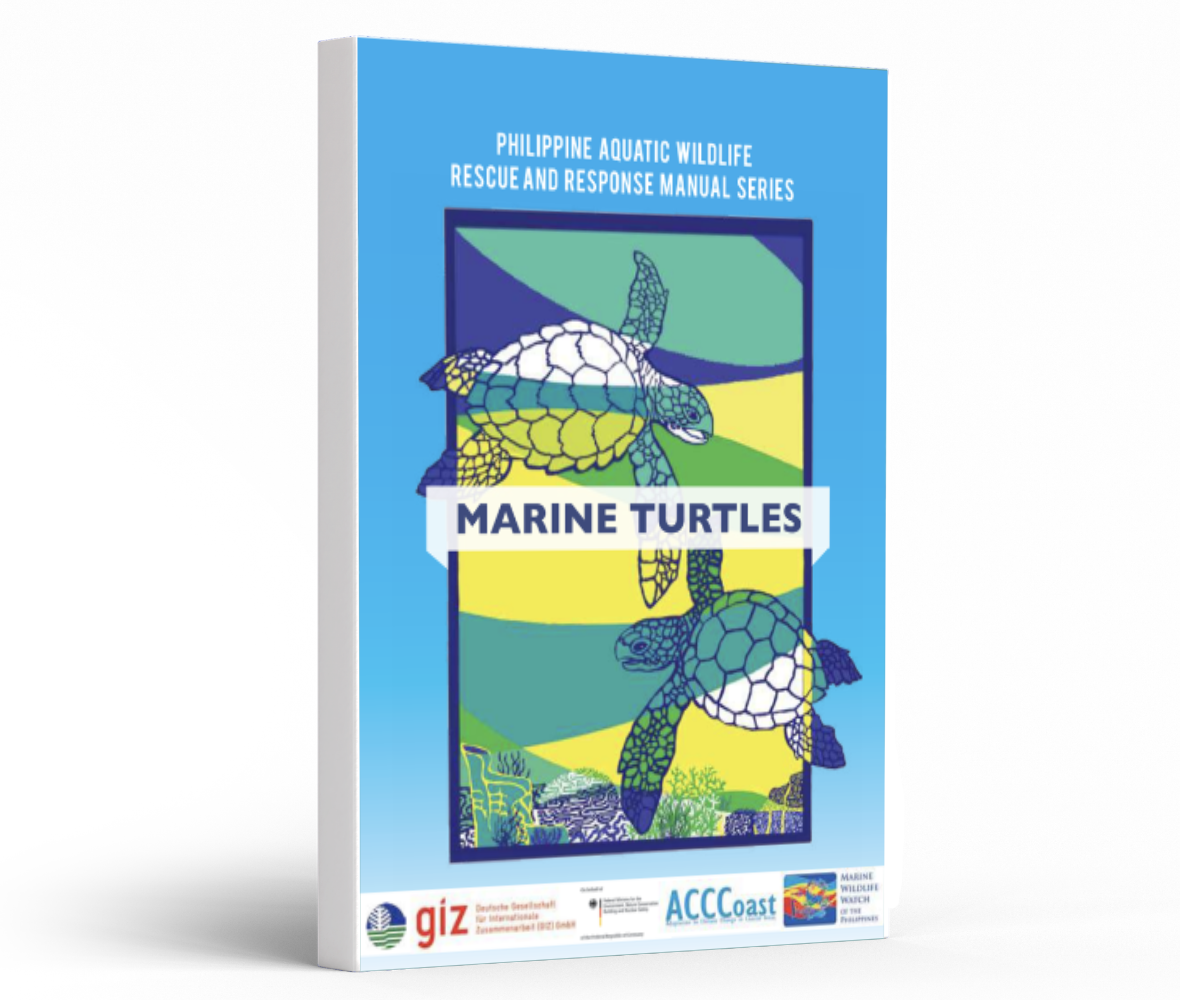
CTC-CFF Thematic Alignment
- Threatened Species
- Marine Protected Area (MPA)
Geographic Scope
- Philippines
Content Language(s)
- English
Introduction/Context
Overview:
This manual provides standardized guidance for the rescue, handling, rehabilitation, monitoring, tagging, hatchery management, and response procedures for marine turtles in the Philippines
Background:
Marine turtles face pressures from habitat degradation, fisheries bycatch, illegal trade, pollution and climate impacts. Limited standardized guidance previously constrained effective response efforts.
Problem statement:
The absence of harmonized rescue and response protocols reduced the effectiveness of marine turtle conservation interventions and coordination among practitioners.
Specific location
Philippines
Geographical detail
Coastal and marine ecosystems across the Philippine archipelago
Scale
National-level application across coastal communities, NGOs and government institutions.
Structure:
To improve wildlife response, the manual first developed standardized rescue and rehabilitation procedures, establishing uniform protocols for safely rescuing, transporting, handling, releasing, and documenting marine turtles to maximize animal welfare. To support these operations, it compiled technical guidance on tagging, hatchery management, and response actions, delivering precise instructions on turtle identification, nesting care, disease management, and proper release techniques.
Furthermore, the manual established incident response procedures for strandings, bycatch, and confiscated turtles by introducing clear decision-making flowcharts for live or dead strandings, fisheries entanglement, and illegal wildlife confiscations. To ensure precise data collection, it created standardized monitoring and reporting forms, providing uniform data sheets, rehabilitation records, tagging logs, and necropsy templates to build a consistent long-term conservation database.
Beyond technical protocols, the framework strengthened coordination among government agencies and conservation organizations, fostering seamless collaboration between environmental departments, local governments, NGOs, and specialized rescue networks to optimize resource sharing and efficiency. Finally, it integrated awareness and education into response systems, embedding public outreach and responder education into daily field operations. This comprehensive approach ensures that local communities and stakeholders are well-equipped to report incidents correctly and actively protect marine turtles.
Furthermore, the manual established incident response procedures for strandings, bycatch, and confiscated turtles by introducing clear decision-making flowcharts for live or dead strandings, fisheries entanglement, and illegal wildlife confiscations. To ensure precise data collection, it created standardized monitoring and reporting forms, providing uniform data sheets, rehabilitation records, tagging logs, and necropsy templates to build a consistent long-term conservation database.
Beyond technical protocols, the framework strengthened coordination among government agencies and conservation organizations, fostering seamless collaboration between environmental departments, local governments, NGOs, and specialized rescue networks to optimize resource sharing and efficiency. Finally, it integrated awareness and education into response systems, embedding public outreach and responder education into daily field operations. This comprehensive approach ensures that local communities and stakeholders are well-equipped to report incidents correctly and actively protect marine turtles.
Success factors:
Critical challenges:
While the initiative has made significant strides, it faces critical challenges that must be addressed to ensure long-term success and replicability across other regions. Chief among these is inconsistent rescue procedures, as varying field protocols across different local networks can lead to fragmented data and compromised animal welfare. This issue is often compounded by variable responder capacity, where a lack of standardized training and uneven resource distribution among coastal communities and local handlers creates gaps in the speed and effectiveness of emergency response operations.
The Breakthrough:
The true breakthrough of the initiative occurred with the pivotal decision to develop and launch a practical, nationally applicable manual. By consolidating fragmented field protocols into a single, official standard, this comprehensive guide successfully bridged the gap between various stakeholders, instantly improving coordination and consistency in marine turtle response efforts across the entire country. This unified framework transformed isolated local conservation attempts into a synchronized, efficient national network capable of delivering rapid and uniform emergency care.
Success factors:
The ultimate success of the initiative relies heavily on several key interconnected success factors. At its core is multi-stakeholder collaboration, which unites government agencies, local communities, and conservation organizations into a single, cohesive network. This collaborative effort is driven by practical field guidance that translates complex protocols into actionable, step-by-step instructions for responders on the ground. To ensure that field efforts yield high-quality conservation data, standardized reporting systems are utilized to maintain consistency and accuracy across all regions. Finally, the entire framework is sustained by strong institutional support, which provides the vital funding, policy backing, and long-term organizational stability required to keep the response network functioning effectively.
Result snapshots:
The initiative achieved significant milestones through these combined actions and success factors, leading to key result snapshots. Most notably, the standardizing of field protocols resulted in improved rescue coordination, enabling different agencies and local networks to act as a synchronized unit during emergencies. This was closely accompanied by enhanced responder capacity, as practical guidelines effectively bridged the skill gaps among local handlers and coastal communities. Finally, the deployment of uniform data sheets led to much better incident documentation, ensuring that strandings, bycatch, and health metrics are accurately recorded to build a high-quality, long-term conservation database.
Transferable tips:
To ensure these conservation practices can be effectively scaled and adapted elsewhere, several transferable tips can be drawn from the initiative's success. First, programs should standardize operational guidance by consolidating disparate local protocols into a single, comprehensive reference manual to ensure procedural alignment. Second, it is vital to strengthen partnerships across government bodies, civil society, and local communities to build a well-coordinated, rapid-response ecosystem. Third, organizations must conduct responder training to continually build local capacity, equalize field skill levels, and elevate animal welfare. Finally, establishing a mandate to use consistent monitoring forms is crucial to maintaining data integrity and generating high-quality datasets for long-term conservation planning.
While the initiative has made significant strides, it faces critical challenges that must be addressed to ensure long-term success and replicability across other regions. Chief among these is inconsistent rescue procedures, as varying field protocols across different local networks can lead to fragmented data and compromised animal welfare. This issue is often compounded by variable responder capacity, where a lack of standardized training and uneven resource distribution among coastal communities and local handlers creates gaps in the speed and effectiveness of emergency response operations.
The Breakthrough:
The true breakthrough of the initiative occurred with the pivotal decision to develop and launch a practical, nationally applicable manual. By consolidating fragmented field protocols into a single, official standard, this comprehensive guide successfully bridged the gap between various stakeholders, instantly improving coordination and consistency in marine turtle response efforts across the entire country. This unified framework transformed isolated local conservation attempts into a synchronized, efficient national network capable of delivering rapid and uniform emergency care.
Success factors:
The ultimate success of the initiative relies heavily on several key interconnected success factors. At its core is multi-stakeholder collaboration, which unites government agencies, local communities, and conservation organizations into a single, cohesive network. This collaborative effort is driven by practical field guidance that translates complex protocols into actionable, step-by-step instructions for responders on the ground. To ensure that field efforts yield high-quality conservation data, standardized reporting systems are utilized to maintain consistency and accuracy across all regions. Finally, the entire framework is sustained by strong institutional support, which provides the vital funding, policy backing, and long-term organizational stability required to keep the response network functioning effectively.
Result snapshots:
The initiative achieved significant milestones through these combined actions and success factors, leading to key result snapshots. Most notably, the standardizing of field protocols resulted in improved rescue coordination, enabling different agencies and local networks to act as a synchronized unit during emergencies. This was closely accompanied by enhanced responder capacity, as practical guidelines effectively bridged the skill gaps among local handlers and coastal communities. Finally, the deployment of uniform data sheets led to much better incident documentation, ensuring that strandings, bycatch, and health metrics are accurately recorded to build a high-quality, long-term conservation database.
Transferable tips:
To ensure these conservation practices can be effectively scaled and adapted elsewhere, several transferable tips can be drawn from the initiative's success. First, programs should standardize operational guidance by consolidating disparate local protocols into a single, comprehensive reference manual to ensure procedural alignment. Second, it is vital to strengthen partnerships across government bodies, civil society, and local communities to build a well-coordinated, rapid-response ecosystem. Third, organizations must conduct responder training to continually build local capacity, equalize field skill levels, and elevate animal welfare. Finally, establishing a mandate to use consistent monitoring forms is crucial to maintaining data integrity and generating high-quality datasets for long-term conservation planning.
Institution:
Department of Environment and Natural Resources (DENR) Philippines
email : web@denr.gov.ph
website : denr.gov.ph