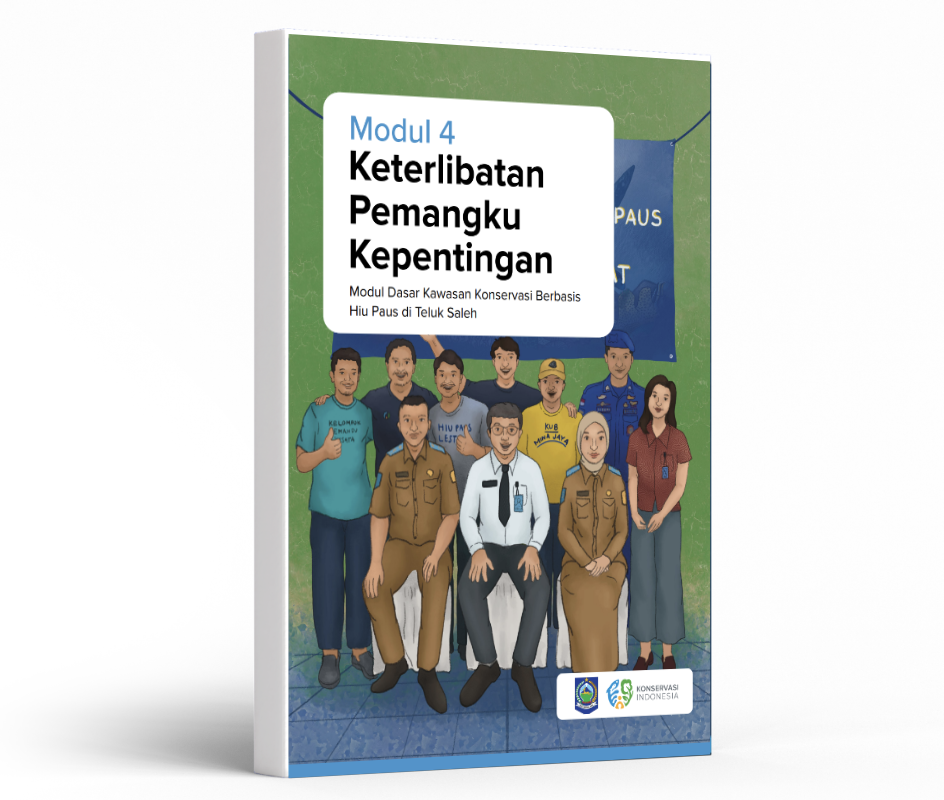
Module 4: Stakeholder Engagement
CTC-CFF Thematic Alignment
- Community-Based Coastal Resource Management (CBCRM)
- Marine Protected Area (MPA)
- Threatened Species
Geographic Scope
- Indonesia
Content Language(s)
- Bahasa Indonesia
Introduction/Context
Overview:
The module outlines critical engagement elements such as identifying key, primary, and secondary stakeholders, integrating invaluable local wisdom like Sasi and Awig-awig, and using analytical tools like SWOT and stakeholder matrices. By evaluating strategic management pathways—specifically contrasting top-down and bottom-up approaches—and promoting collaborative co-management structures shared between government authorities and coastal communities, this resource serves as a practical framework for building local trust, ensuring regulatory compliance, and achieving long-term marine biodiversity preservation
Background:
Marine conservation initiatives are highly dependent on the support and participation of the people and institutions connected to marine ecosystems. Conservation areas often face challenges such as conflict over resource access, limited public support, and non-compliance with regulations when local communities and stakeholders are excluded from decision-making processes. Effective conservation therefore requires collaboration between government institutions, local communities, fisheries sectors, tourism operators, researchers, NGOs, and the private sector.
The module emphasizes that integrating local knowledge, cultural practices, and community needs into conservation planning can improve legitimacy, strengthen ownership, and increase the long-term sustainability of marine conservation efforts.
Problem statement:
Many marine conservation initiatives struggle due to insufficient stakeholder engagement, weak communication, and limited collaboration between institutions and local communities. This module addresses these challenges by providing practical approaches for stakeholder analysis, engagement strategies, conflict resolution, and co-management systems.
Specific location
Teluk Saleh, Sumbawa, West Nusa Tenggara, Indonesia
Geographical detail
Coastal and marine ecosystems including coral reefs, pelagic habitats, fisheries areas, and whale shark aggregation sites within the Teluk Saleh conservation landscape.
Scale
Training module designed for local conservation management application with relevance across marine conservation initiatives in the Coral Triangle region.
Structure:
1. Introduce stakeholder concepts and conservation governance
Explain the definition, roles, and importance of stakeholders in marine conservation planning and management.
2. Identify key stakeholders
Map relevant stakeholders, including local communities, government institutions, fisheries sectors, tourism operators, NGOs, researchers, and private sector actors.
3. Conduct stakeholders analysis
Assess stakeholder influence, interest, and support levels using stakeholder analysis matrices and participatory discussion tools.
4. Facilitate participatory engagement
Implement workshops, focus group discussions, public consultations, and collaborative planning sessions.
5. Develop communication channels
Establish transparent communication mechanisms to improve information sharing, accountability, and trust among stakeholders.
6. Address conflicts and competing interests
Apply negotiation, mediation, and participatory conflict resolution approaches to balance conservation and livelihood needs.
7. Promote co-management approaches
Encourage shared management responsibilities between government agencies and local communities through collaborative governance systems.
8. Strengthen local participation and capacity
Support local leadership, community-based management systems, and integration of traditional knowledge and customary practices.
9. Apply adaptive and collaborative management
Regularly evaluate stakeholder participation processes and improve engagement strategies based on feedback and conservation outcomes.
Explain the definition, roles, and importance of stakeholders in marine conservation planning and management.
2. Identify key stakeholders
Map relevant stakeholders, including local communities, government institutions, fisheries sectors, tourism operators, NGOs, researchers, and private sector actors.
3. Conduct stakeholders analysis
Assess stakeholder influence, interest, and support levels using stakeholder analysis matrices and participatory discussion tools.
4. Facilitate participatory engagement
Implement workshops, focus group discussions, public consultations, and collaborative planning sessions.
5. Develop communication channels
Establish transparent communication mechanisms to improve information sharing, accountability, and trust among stakeholders.
6. Address conflicts and competing interests
Apply negotiation, mediation, and participatory conflict resolution approaches to balance conservation and livelihood needs.
7. Promote co-management approaches
Encourage shared management responsibilities between government agencies and local communities through collaborative governance systems.
8. Strengthen local participation and capacity
Support local leadership, community-based management systems, and integration of traditional knowledge and customary practices.
9. Apply adaptive and collaborative management
Regularly evaluate stakeholder participation processes and improve engagement strategies based on feedback and conservation outcomes.
Success factors:
1. Strong stakeholder participation and communication
2. Integration of local knowledge and customary governance systems
3. Transparent and inclusive decision-making processes
4. Collaborative co-management approaches
5. Interactive and participatory learning methods
2. Integration of local knowledge and customary governance systems
3. Transparent and inclusive decision-making processes
4. Collaborative co-management approaches
5. Interactive and participatory learning methods
Critical challenges:
Balancing conservation objectives with community livelihoods, fisheries interests, tourism activities and institutional priorities.
The Breakthrough:
Participatory stakeholder analysis and co-management approaches helped improve trust, communication, and long-term stakeholder support.
Success factors:
1. Early stakeholder engagement
2. Transparent communication systems
3. Recognition of local knowledge and customary practices
4. Shared management responsibilities
5. Continuous participation and capacity development
Result snapshots:
Improved participant understanding of stakeholder roles, engagement strategies, and collaborative governance approaches for marine conservation.
Transferable tips:
1. Involve stakeholders from the beginning of the planning processes
2. Use participatory tools such as stakeholder matrices and SWOT analysis
3. Integrate local and traditional knowledge systems
4. Build trust through regular communication
5. Establish clear shared responsibilities within co-management frameworks
Balancing conservation objectives with community livelihoods, fisheries interests, tourism activities and institutional priorities.
The Breakthrough:
Participatory stakeholder analysis and co-management approaches helped improve trust, communication, and long-term stakeholder support.
Success factors:
1. Early stakeholder engagement
2. Transparent communication systems
3. Recognition of local knowledge and customary practices
4. Shared management responsibilities
5. Continuous participation and capacity development
Result snapshots:
Improved participant understanding of stakeholder roles, engagement strategies, and collaborative governance approaches for marine conservation.
Transferable tips:
1. Involve stakeholders from the beginning of the planning processes
2. Use participatory tools such as stakeholder matrices and SWOT analysis
3. Integrate local and traditional knowledge systems
4. Build trust through regular communication
5. Establish clear shared responsibilities within co-management frameworks
Institution:
Konservasi Indonesia
email : -
website : konservasi-id.org/