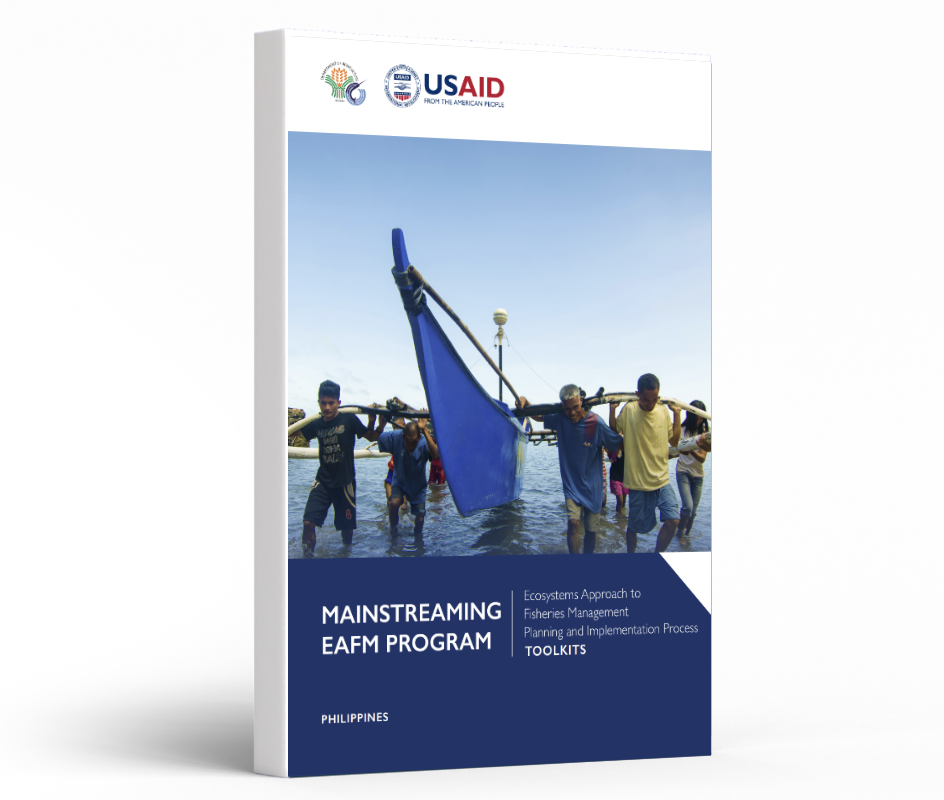
Mainstreaming EAFM Program: Ecosystem Approach to Fisheries Management Planning and Implementation Process Toolkits
CTC-CFF Thematic Alignment
- Ecosystems Approach to Fisheries Management (EAFM)
Geographic Scope
- Philippines
Content Language(s)
- English
Introduction/Context
Overview:
The Mainstreaming EAFM Program: Ecosystem Approach to Fisheries Management Planning and Implementation Process Toolkits is a practical, stakeholder-driven knowledge product developed in the Philippines to support local government units (LGUs), fisheries managers, and coastal communities in implementing ecosystem-based fisheries management. Implemented by the Bureau of Fisheries and Aquatic Resources (BFAR) alongside USAID Philippines, this tool provides a structured, participatory framework to address critical coastal pressures such as overfishing, habitat degradation, and resource-use conflicts across municipal waters. By combining essential legal, governance, and environmental strategies, the toolkit operationalizes crucial field processes—including governance benchmarking, municipal ordinance reviews, marine spatial planning, illegal fishing threat mapping, and inter-LGU collaboration—to ensure sustainable, ecosystem-scale fisheries governance throughout the Philippine archipelago.
Background:
Fisheries and coastal ecosystems in the Philippines face increasing pressures from overfishing, habitat degradation, illegal fishing, coastal development, and rescue-use conflicts. Traditional fisheries management approaches often focused only on fish production without sufficiency addressing ecosystem health, governance, stakeholder participation, and cross-sectoral interactions.
Problem statement:
Many LGUs and fisheries managers lacked practical and structured tools to implement ecosystem-based fisheries management effectively at the municipal and inter-LGU scales. There was a need for simplified, participatory, and operational EAFM tools that could support governance benchmarking, ordinance review, marine spatial planning, conflict mapping, and threat assessment.
Specific location
Philippines
Geographical detail
Municipal waters, fisheries management areas (FMAs), coastal ecosystems, and inter-LGU coastal management areas across the Philippine archipelago.
Scale
National and local implementation involving LGUs, BFAR, FARMCs, fisheries managers, coastal communities, and inter-LGU alliances.
Structure:
1. Conduct EAFM governance benchmarking and self-assessment
LGUs and stakeholders use the EAFM governance benchmarking tool to assess fisheries governance capacity, identify gaps, measure progress, and prioritize improvements across key governance indicators and management actions.
2. Review and strengthen municipal fisheries ordinances.
The toolkit guides LGUs in reviewing existing municipal fisheries ordinances to align with the Revised Fisheries Code, strengthen fisheries regulations, improve enforcement provisions, and address local fisheries management priorities.
3. Identify coastal resource use interactions and conflicts through participatory mapping.
Interaction matrices and conflict-mapping exercises are used to identify overlapping activities, resource-use conflicts, and stakeholder interests to support collaborative fisheries and coastal management planning.
4. Conduct marine spatial planning and zoning discussions
Stakeholders use mapping tools and zoning discussions to identify appropriate fisheries use areas, reduce resource-use conflicts, support ecosystem protection, and guide marine spatial planning decisions.
5. Map IUU Fishing Threats and Enforcement Priorities
Threat mapping tools are used to identify locations, frequency, and types of illegal, unreported, and unregulated (IUU) fishing and other coastal threats to support fisheries law enforcement planning and prioritization.
6. Strengthen fisheries law enforcement planning and coordination
The toolkit supports the development of fisheries law enforcement programs, operational plans, inter-agency coordination, monitoring systems, and collaborative enforcement activities across LGUs and agencies.
LGUs and stakeholders use the EAFM governance benchmarking tool to assess fisheries governance capacity, identify gaps, measure progress, and prioritize improvements across key governance indicators and management actions.
2. Review and strengthen municipal fisheries ordinances.
The toolkit guides LGUs in reviewing existing municipal fisheries ordinances to align with the Revised Fisheries Code, strengthen fisheries regulations, improve enforcement provisions, and address local fisheries management priorities.
3. Identify coastal resource use interactions and conflicts through participatory mapping.
Interaction matrices and conflict-mapping exercises are used to identify overlapping activities, resource-use conflicts, and stakeholder interests to support collaborative fisheries and coastal management planning.
4. Conduct marine spatial planning and zoning discussions
Stakeholders use mapping tools and zoning discussions to identify appropriate fisheries use areas, reduce resource-use conflicts, support ecosystem protection, and guide marine spatial planning decisions.
5. Map IUU Fishing Threats and Enforcement Priorities
Threat mapping tools are used to identify locations, frequency, and types of illegal, unreported, and unregulated (IUU) fishing and other coastal threats to support fisheries law enforcement planning and prioritization.
6. Strengthen fisheries law enforcement planning and coordination
The toolkit supports the development of fisheries law enforcement programs, operational plans, inter-agency coordination, monitoring systems, and collaborative enforcement activities across LGUs and agencies.
Success factors:
1. Strong participation from LGUs, BFAR, FARMCs, and stakeholders
2. Practical and participatory planning approaches
3. Integration of governance, law enforcement, and ecosystem management
4. Use of visual mapping and benchmarking tools
5. Promotion of inter-LGU collaboration and ecosystem-scale planning
2. Practical and participatory planning approaches
3. Integration of governance, law enforcement, and ecosystem management
4. Use of visual mapping and benchmarking tools
5. Promotion of inter-LGU collaboration and ecosystem-scale planning
Critical challenges:
1. Limited technical and institutional capacity among LGUs
2. Fragmented fisheries governance and inter-LGU coordination
3. Limited access to practical EAFM planning toolds and data utilization
The Breakthrough:
The development of simplified and participatory EAFM toolkits enabled LGUs and stakeholders to operationalize ecosystem-based fisheries management using practical governance, mapping and planning approaches.
Success factors:
1. Participatory and stakeholder-driven planning process
2. Practical and easy-to-use toolkits
3. Integration of governance, law enforcement, and ecosystem management
4. Strong institutional support from BFAR and partners
5. Emphasis on ecosystem-scale and inter-LGU collaboration
Result snapshots:
1. Improved LGU capacity for EAFM implementation
2. Strengthened fisheries governance and planning systems
3. Better identification of resource-use conflicts and IUU fishing threats
4. Enhanced collaboration among fisheries stakeholders
Transferable tips:
1. Use participatory mapping and benchmarking approaches.
2. Link governance indicators with environmental outcomes.
3. Promote ecosystem-scale collaboration among LGUs
4. Integrate legal, governance, and ecosystem considerations into fisheries management planning.
5. Conduct regular monitoring and governance assessments.
1. Limited technical and institutional capacity among LGUs
2. Fragmented fisheries governance and inter-LGU coordination
3. Limited access to practical EAFM planning toolds and data utilization
The Breakthrough:
The development of simplified and participatory EAFM toolkits enabled LGUs and stakeholders to operationalize ecosystem-based fisheries management using practical governance, mapping and planning approaches.
Success factors:
1. Participatory and stakeholder-driven planning process
2. Practical and easy-to-use toolkits
3. Integration of governance, law enforcement, and ecosystem management
4. Strong institutional support from BFAR and partners
5. Emphasis on ecosystem-scale and inter-LGU collaboration
Result snapshots:
1. Improved LGU capacity for EAFM implementation
2. Strengthened fisheries governance and planning systems
3. Better identification of resource-use conflicts and IUU fishing threats
4. Enhanced collaboration among fisheries stakeholders
Transferable tips:
1. Use participatory mapping and benchmarking approaches.
2. Link governance indicators with environmental outcomes.
3. Promote ecosystem-scale collaboration among LGUs
4. Integrate legal, governance, and ecosystem considerations into fisheries management planning.
5. Conduct regular monitoring and governance assessments.
Institution:
Bureau of Fisheries and Aquatic Resources (BFAR)
email : info@bfar.da.gov.ph
website : bfar.da.gov.ph