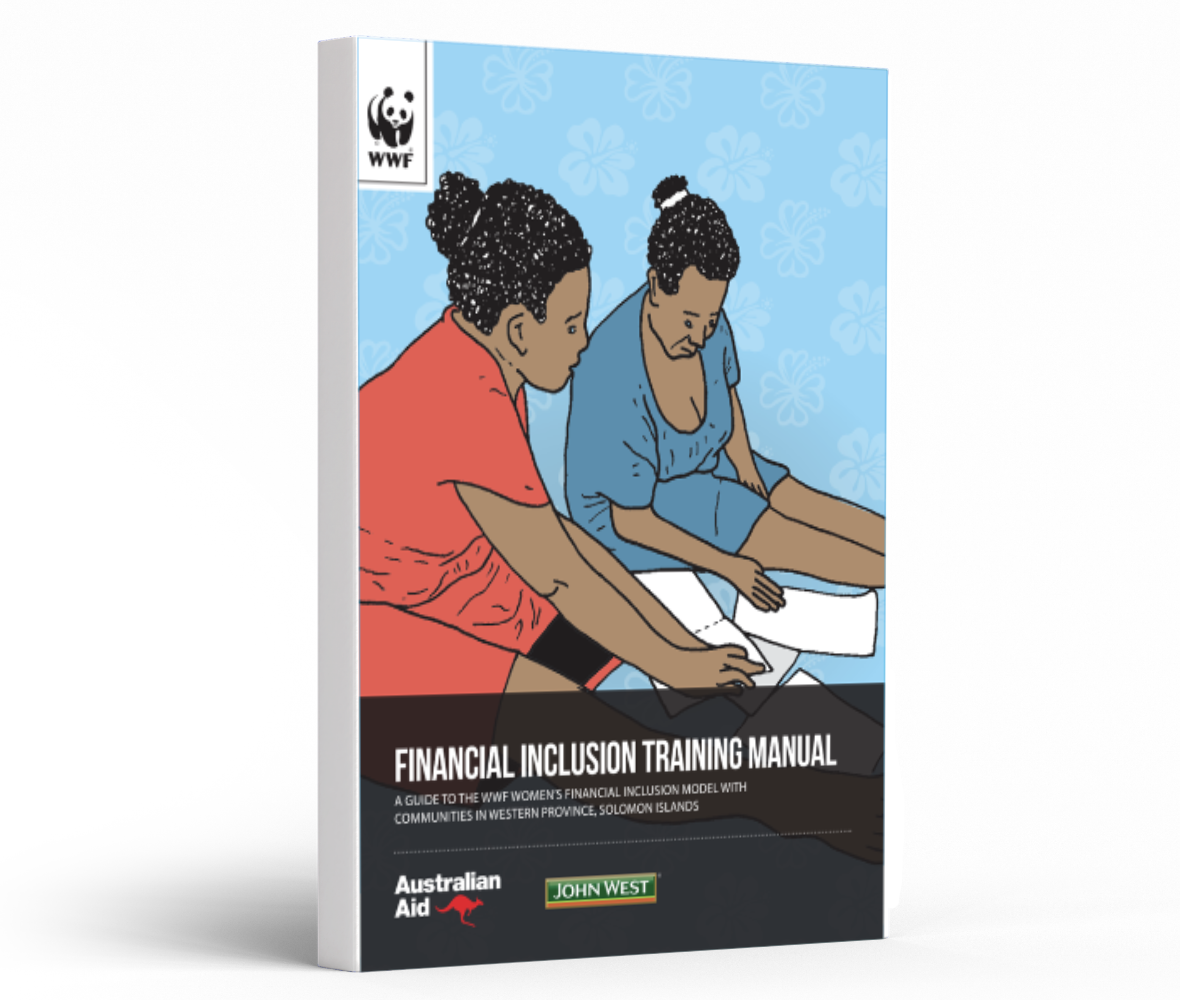
The Financial Inclusion Training Manual
CTC-CFF Thematic Alignment
Geographic Scope
Content Language(s)
Introduction/Context
Overview:
The Financial Inclusion Training Manual developed by WWF-Pacific (Solomon Islands) provides a practical guide for establishing and managing women-led savings clubs in rural and coastal communities in Western Province, Solomon Islands. The Manual combines financial literacy, governance, savings management, loan systems, and sustainable livelihood development while integrating environmental sustainability principles into financial inclusion initiatives.
Background:
The model was adapted from the West ‘Are’Are Rokotanikeni Association (WARA) financial inclusion model initiated by Dr Alice Aruhe’eta Pollard to empower women in rural Solomon Islands. WWF integrated this approach into its Sustainable and Resilient Island Communities Programme to strengthen women’s economic empowerment, support sustainable livelihoods, and reduce pressure on marine and coastal resources.
Problem statement:
Many women in remote island communities face limited access to banking services, financial literacy, small business opportunities, and decision-making power over household finances. Communities also depend heavily on natural resources for livelihoods, creating risks of unsustainable resource use when alternative income opportunities are limited. The training manual was developed to strengthen women’s financial skills, savings behavior, small business development, and sustainable livelihood opportunities while promoting environmental stewardship.
Specific location
Western Province, Solomon Islands
Geographical detail
Remote island and coastal comunities involved in WWF’s Sustainable and Resilient Island Communities Programme
Scale
Community-based women’s savings clubs and financial inclusion initiatives operating across rural communities in Western Province and adaptable to Pacific Island and Coral Triangle contexts.
Structure:
Conduct community awareness and consultations
Introduce financial inclusion concepts and discuss community interest in savings clubs linked to sustainable fisheries and livelihood programs.
Facilitate community invitations and commitment
Communities formally request support and identify women interested in participating in and leading savings clubs.
Deliver financial literacy training
Provide training on money management, savings, budgeting, goal setting, needs versus wants, and financial discipline.
Establish women’s savings clubs and governance structures
Form savings club committess including presidents, treasurers, secretaries, and money counters with clearly defined responsibilities.
Develop savings systems and financial recording processes
Train members on passbooks, record bookds, tally sheets, deposits, withdrawals, audits, and transparent bookkeeping procedures.
Introduce governance and administration systems
Strengthen leadership, accountability, transparency and operational management of savings clubs
Establish revolving funds and loan schemes
Create community-managed microfinance systems that provide small loans to members for sustainable livelihood activities
Apply sustainability criteria for loans and businesses
Ensure loans support environmentally sustainable, socially responsible, and economically viable activities
Support business development and additional training
Provide leadership, business planning, management, and entrepreneurship training to strengthen women-led enterprises.
Conduct monitoring, audits, and ongoing learning
Undertake regular balance and action audits, monitoring, mentoring, and knowledge sharing to maintain accountability and sustainability.
Introduce financial inclusion concepts and discuss community interest in savings clubs linked to sustainable fisheries and livelihood programs.
Facilitate community invitations and commitment
Communities formally request support and identify women interested in participating in and leading savings clubs.
Deliver financial literacy training
Provide training on money management, savings, budgeting, goal setting, needs versus wants, and financial discipline.
Establish women’s savings clubs and governance structures
Form savings club committess including presidents, treasurers, secretaries, and money counters with clearly defined responsibilities.
Develop savings systems and financial recording processes
Train members on passbooks, record bookds, tally sheets, deposits, withdrawals, audits, and transparent bookkeeping procedures.
Introduce governance and administration systems
Strengthen leadership, accountability, transparency and operational management of savings clubs
Establish revolving funds and loan schemes
Create community-managed microfinance systems that provide small loans to members for sustainable livelihood activities
Apply sustainability criteria for loans and businesses
Ensure loans support environmentally sustainable, socially responsible, and economically viable activities
Support business development and additional training
Provide leadership, business planning, management, and entrepreneurship training to strengthen women-led enterprises.
Conduct monitoring, audits, and ongoing learning
Undertake regular balance and action audits, monitoring, mentoring, and knowledge sharing to maintain accountability and sustainability.
Success factors:
Strong women-led community participation
Transparent financial recording and auditing systems
Integration of financial inclusion and environmental sustainability
Practical hands-on training approaches
Strong local leadership and ownership
Ongoing mentoring and capacity building
Transparent financial recording and auditing systems
Integration of financial inclusion and environmental sustainability
Practical hands-on training approaches
Strong local leadership and ownership
Ongoing mentoring and capacity building
Critical challenges:
Limited financial access, low financial literacy, remoteness of communities, and balancing livelihood development with sustainable resource management.
The Breakthrough:
Adapting the WARA women’s savings model into WWF’s community-based conservation and livelihood programs created a culturally relevant and environmentally responsible financial inclusion model.
Success factors:
Women-centered and community-led approach
Transparent governance and financial systems
Integration of sustainability criteria into loan systems
Practical financial literacy and business training
Continuous monitoring and mentoring support
Result snapshots:
Improved women’s savings behavior, financial literacy, leadership participation, and access to sustainable livelihood opportunities in remote island communities.
Transferable tips:
Strart with strong financial literacy foundations
Build trust and transparency through audits and record keeping
Integrate environmental sustainability into livelihood financing
Use simple and locally understandable financial tools
Support women’s leadership and peer learning networks
Limited financial access, low financial literacy, remoteness of communities, and balancing livelihood development with sustainable resource management.
The Breakthrough:
Adapting the WARA women’s savings model into WWF’s community-based conservation and livelihood programs created a culturally relevant and environmentally responsible financial inclusion model.
Success factors:
Women-centered and community-led approach
Transparent governance and financial systems
Integration of sustainability criteria into loan systems
Practical financial literacy and business training
Continuous monitoring and mentoring support
Result snapshots:
Improved women’s savings behavior, financial literacy, leadership participation, and access to sustainable livelihood opportunities in remote island communities.
Transferable tips:
Strart with strong financial literacy foundations
Build trust and transparency through audits and record keeping
Integrate environmental sustainability into livelihood financing
Use simple and locally understandable financial tools
Support women’s leadership and peer learning networks
Institution:
World Wildlife Fund (WWF)
email : info@wwf.org
website : wwf.org/