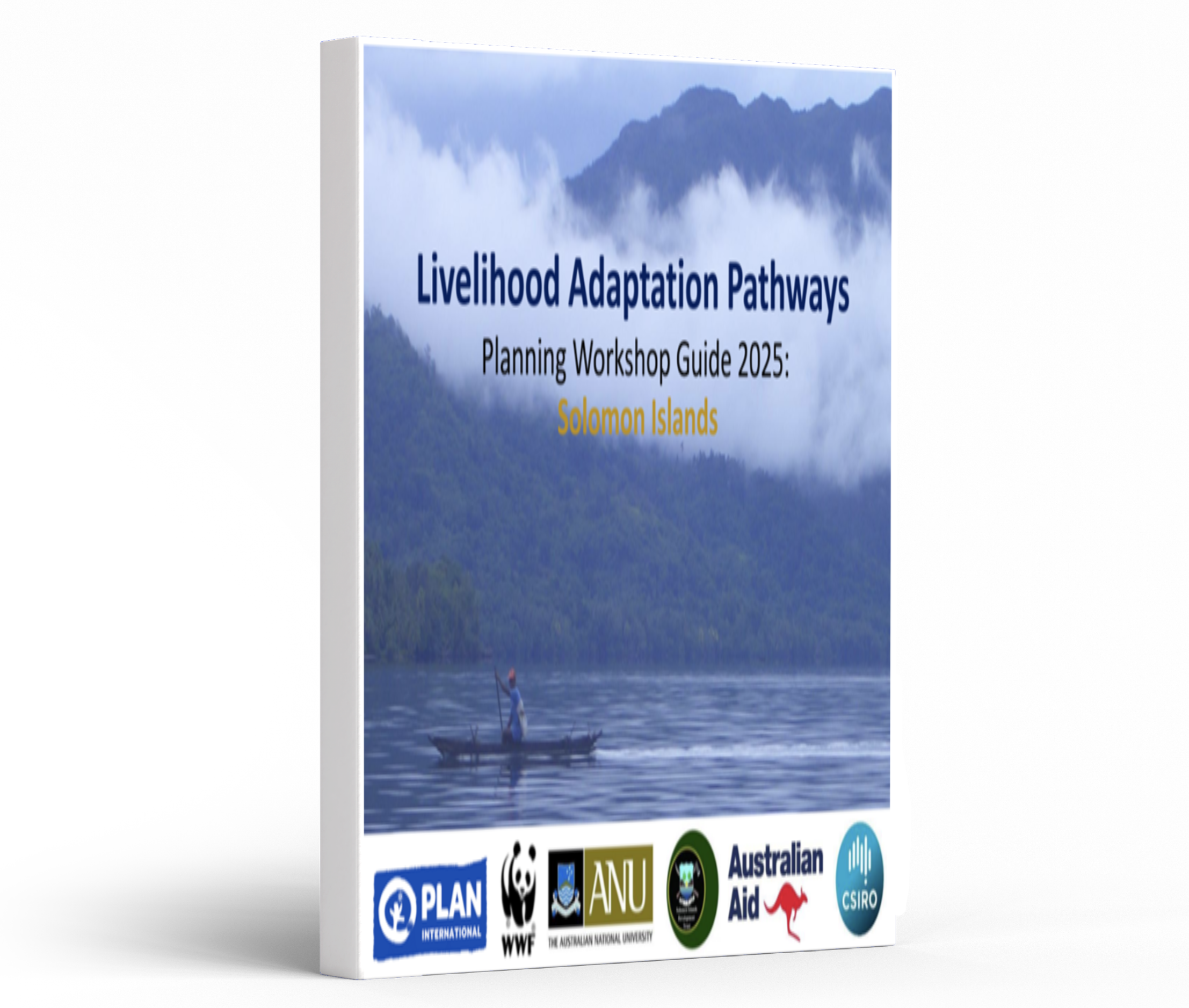
The Livelihood Adaptation Pathways Planning Workshop Guide 2025
CTC-CFF Thematic Alignment
- Climate change
Geographic Scope
- Solomon Islands
Content Language(s)
- English
Introduction/Context
Overview:
The Livelihood Adaptation Pathways Planning Workshop Guide 2025: Solomon Islands is a participatory planning and capacity-building toolkit designed to support communities, facilitators, and stakeholders in developing long-term livelihood adaptation strategies under conditions of climate change, environmental pressures, and socio-economic uncertainty.
Background:
Communities across the Solomon Islands face increasing pressures from climate change, sea level rise, natural disasters, population growth, economic instability, and changing resource availability. The guide was developed through the Community-led Adaptation Pathways in the Solomon Islands Project, led by WWF, Plan International, CSIRO, ANU, and Solomon Islands Development Trust.
Problem statement:
Many coastal and island communities remain vulnarable to climate impacts, livelihood insecurity, and limited adaptive capacity. There is a need for practical and participatory tools that help communities anticipate future change, strengthen resilience, prioritize “no regrets” adaptation strategies, and develop pathways for long-term action and decision-making.
Specific location
Solomon Islands communities including Tasimboko, Riguru, Kolombangara, and Ontong Java.
Geographical detail
Coastal and island communities vulnerable to climate change, sea level rise, natural disasters, and livelihood pressures.
Scale
Community and provincial-level participatory planning procfesses applicable across Pacific Island and Coral Triangle coastal communities.
Structure:
Introduce adaptation pathways and livelihood concepts
Introduce the concepts of livelihoods, adaptive capacity, climate change impacts, and adaptation pathways through participatory discussions and practical examples.
Identify drivers of change affecting livelihoods.
Assess environmental, social, political, and climate-related factors that influence community livelihoods and future resilience.
Develop community livelihoods visions.
Facilitate community visioning exercises to identify desired future livelihood conditions, goals, and long-term aspirations.
Explore possible future scenarios
Use storytelling, scenario planning, and group discussions to explore best-case, worst-case, and alternative future conditions affecting livelihoods and community well-being.
Asses current adaptive capacity
Analyze strengths, weakness, resources, and existing capacities across livelihood capirals such as natural, financial, social, physical, and human assets.
Identify no-regrets adaptation strategies
Develop practical adaptation actions that provide benefits under multiple future scenarios and reduce long-term vulnerability regardless of uncertainty.
Design adaptation pathways
Map out sequences of actions, partnerships, decisions, and timelines needed to implement adaptation strategies over time.
Facilitate participatory reflection and learning
Encourage collaborative discussions, knowledge sharing, reflection exercises, and active participation throughout the workshop process.
Strengthen stakeholder coordination
Promote collaboration between communities, government agencies, NGOs, and development partners to support coordinated adaptation planning and implementation.
Evaluate workshop outcomes and next steps
Review lessons learned, identify follow-up actions, clarify responsi
Introduce the concepts of livelihoods, adaptive capacity, climate change impacts, and adaptation pathways through participatory discussions and practical examples.
Identify drivers of change affecting livelihoods.
Assess environmental, social, political, and climate-related factors that influence community livelihoods and future resilience.
Develop community livelihoods visions.
Facilitate community visioning exercises to identify desired future livelihood conditions, goals, and long-term aspirations.
Explore possible future scenarios
Use storytelling, scenario planning, and group discussions to explore best-case, worst-case, and alternative future conditions affecting livelihoods and community well-being.
Asses current adaptive capacity
Analyze strengths, weakness, resources, and existing capacities across livelihood capirals such as natural, financial, social, physical, and human assets.
Identify no-regrets adaptation strategies
Develop practical adaptation actions that provide benefits under multiple future scenarios and reduce long-term vulnerability regardless of uncertainty.
Design adaptation pathways
Map out sequences of actions, partnerships, decisions, and timelines needed to implement adaptation strategies over time.
Facilitate participatory reflection and learning
Encourage collaborative discussions, knowledge sharing, reflection exercises, and active participation throughout the workshop process.
Strengthen stakeholder coordination
Promote collaboration between communities, government agencies, NGOs, and development partners to support coordinated adaptation planning and implementation.
Evaluate workshop outcomes and next steps
Review lessons learned, identify follow-up actions, clarify responsi
Success factors:
Strong community participation and ownership
Interactive and visual learning approaches
Integration of local kowledge and future planning
Multi-stakeholder collaboration and trust building
Interactive and visual learning approaches
Integration of local kowledge and future planning
Multi-stakeholder collaboration and trust building
Critical challenges:
Addressing future uncertainty, climate risks, and diverse stakeholder priorities while maintaining strong community engagement.
The Breakthrough:
Using participatory scenario planning and adaptation pathways enabled communities to visualise future risks and identify practical “no regrets” strategies
Success factors:
Participatory and community-led facilitation
Integration of local and scientific knowledge
Scenario planning and adaptive thinking
Strong stakeholder engagement
Result snapshots:
Improved community understanding of climate risks, adaptation options, livelihood planning, and collaborative decision-making processes
Transferable tips:
Use visual and participatory facilitation tools
Integrate local knowledge into adaptation planning
Focus on practical “no regrets” strategies
Addressing future uncertainty, climate risks, and diverse stakeholder priorities while maintaining strong community engagement.
The Breakthrough:
Using participatory scenario planning and adaptation pathways enabled communities to visualise future risks and identify practical “no regrets” strategies
Success factors:
Participatory and community-led facilitation
Integration of local and scientific knowledge
Scenario planning and adaptive thinking
Strong stakeholder engagement
Result snapshots:
Improved community understanding of climate risks, adaptation options, livelihood planning, and collaborative decision-making processes
Transferable tips:
Use visual and participatory facilitation tools
Integrate local knowledge into adaptation planning
Focus on practical “no regrets” strategies
Institution:

World Wildlife Fund (WWF)
email : info@wwf.org
website : wwf.org/