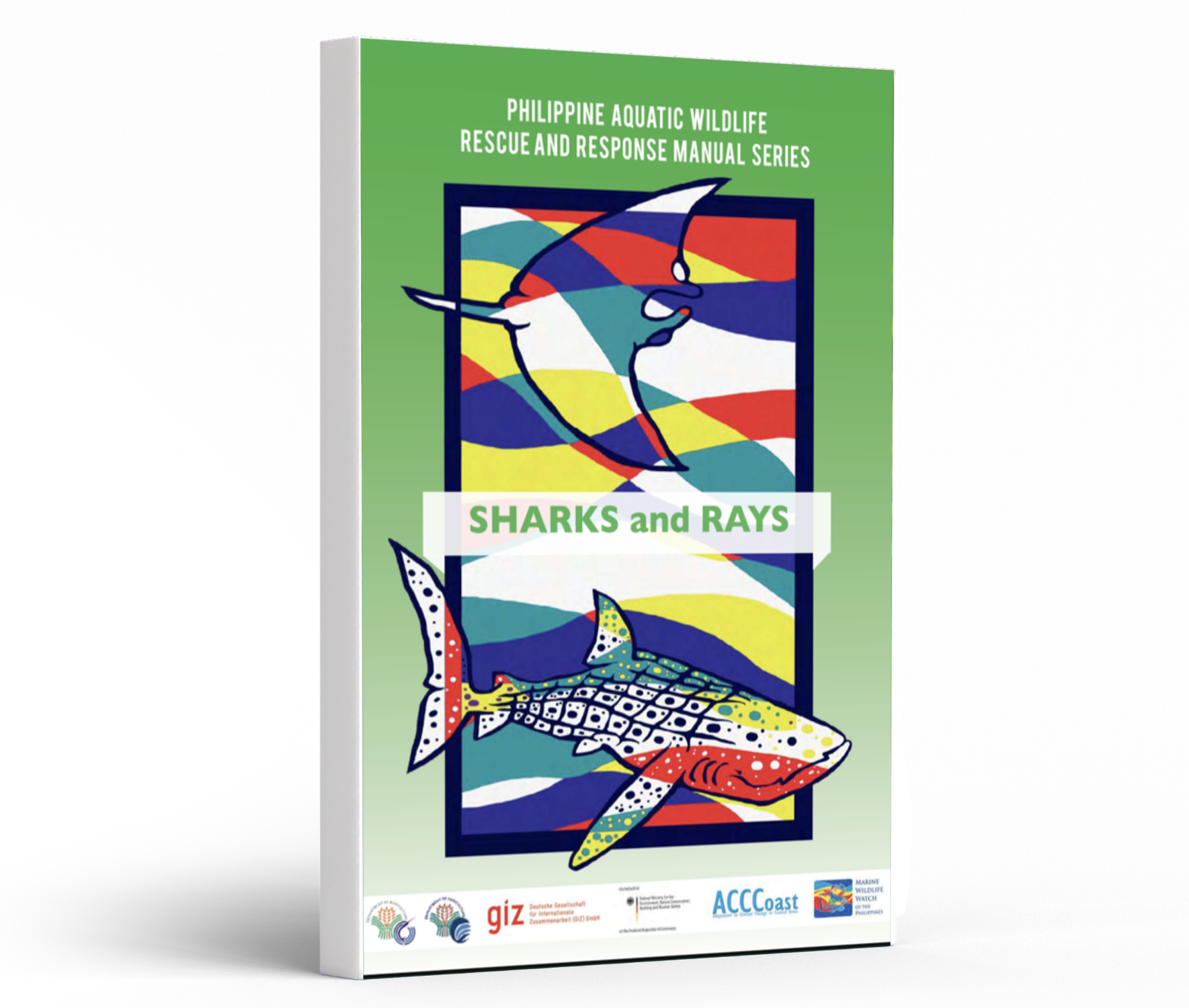
Philippine Aquatic Wildlife Rescue and Response Manual Series: Sharks and Rays
CTC-CFF Thematic Alignment
- Threatened Species
Geographic Scope
- Philippines
Content Language(s)
- English
Introduction/Context
Overview:
The “Philippine Aquatic Wildlife Rescue and Response Manual Series: Sharks and Rays” was developed to establish standardized rescue, response, rehabilitation, monitoring and documentation procedures for sharks and rays in the Philippines.
Background:
Sharks and rays are ecologically important marine species facing threats from fisheries interactions, bycatch, strandings, habitat degradation, pollution, marine debris, and unsustainable exploitation. The Philippines hosts numerous shark and ray species, including threathened species such as whale sharks and manta rays.
Problem statement:
Prior to the development of this manual, rescure and response procedures varied significantly across regions and institutions, reducing the effectiveness and safety of conservation actions and incident response operations.
Specific location
Philippines
Geographical detail
Coastal and marine ecosystems across the Philippine archipelago, including fisheries areas, marine protected areas, ecotourism sites, and stranding hotspots.
Scale
National-level implementation involving government agencies, NGOs, researchers, conservation practitioners, and coastal communities
Structure:
To optimize marine wildlife response, the manual first developed standardized rescue and response procedures for sharks and rays, establishing clear, step-by-step operational workflows to improve consistency, effectiveness, and responder safety across the Philippines. Supporting these operations, it compiled technical guidance on species identification, handling, rehabilitation, and release, delivering practical insights into elasmobranch biology, restraint, and acclimatization, with special attention given to large species like whale sharks and manta rays.
Furthermore, the framework established operational procedures for strandings and bycatch incidents, providing structured response protocols for live strandings, accidental captures, and distressed wildlife alongside detailed metrics for animal assessment, transport, and necropsies. To capture this critical information, the initiative developed monitoring, reporting, and documentation systems, embedding standardized data collection forms and scientific protocols to secure high-quality, long-term conservation data.
Beyond field-level actions, the strategy worked to strengthen coordination among responders, agencies, and conservation organizations, fostering collaborative networks between government bodies, researchers, and local coastal communities to streamline emergency response times. Finally, it integrated responder training and awareness-building into conservation efforts, utilizing clear, illustrated guidance to build local capacity among coastal resource managers while encouraging safer, community-led wildlife protection practices.
Furthermore, the framework established operational procedures for strandings and bycatch incidents, providing structured response protocols for live strandings, accidental captures, and distressed wildlife alongside detailed metrics for animal assessment, transport, and necropsies. To capture this critical information, the initiative developed monitoring, reporting, and documentation systems, embedding standardized data collection forms and scientific protocols to secure high-quality, long-term conservation data.
Beyond field-level actions, the strategy worked to strengthen coordination among responders, agencies, and conservation organizations, fostering collaborative networks between government bodies, researchers, and local coastal communities to streamline emergency response times. Finally, it integrated responder training and awareness-building into conservation efforts, utilizing clear, illustrated guidance to build local capacity among coastal resource managers while encouraging safer, community-led wildlife protection practices.
Success factors:
The initiative's long-term viability and impact are driven by several core success factors. At the foundation is strong institutional collaboration, which successfully unites diverse national and international agencies to synchronize conservation goals. This is translated into on-the-ground action through practical and illustrated field guidance, giving responders clear, visual references during high-pressure rescue scenarios. To maintain operational consistency across all regions, standardized response systems are utilized to unify emergency steps and safety protocols. Furthermore, the integration of conservation science and field operations ensures that every field action is scientifically grounded while generating high-quality data to inform future management policies. Finally, the framework is sustained by continuous training and awareness building, which steadily elevates the skills of coastal managers and local communities to cultivate a permanent, proactive culture of marine conservation.
Critical challenges:
The shark and ray conservation initiative achieved notable milestones across its target locations, resulting in several important breakthroughs. Most significantly, the standardization of field guidelines led to improved rescue coordination, transforming independent efforts into a synchronized regional network during emergency strandings. This was closely supported by enhanced responder capacity, effectively closing the technical skills gap among municipal enforcement teams and local fishers. Finally, the introduction of uniform protocols resulted in better incident documentation, ensuring that all genetic samples, measurements, and post-mortem findings are captured consistently to build a valuable, long-term scientific database.
The Breakthrough:
The initiative achieved a defining breakthrough with the pivotal decision to develop a standardized national rescue and response manual. By unifying scattered field practices into a single, official protocol, this guide bridged the gap between various stakeholders, instantly improving coordination, responder effectiveness, and conservation outcomes for sharks and rays. This strategic shift successfully elevated localized, ad-hoc interventions into a highly synchronized national response system, ensuring that threatened elasmobranch species receive consistent and scientifically sound care during strandings and bycatch incidents.
Success factors:
The initiative's sustained impact relies heavily on several key success factors. At its foundation is strong collaboration between agencies and conservation partners, which effectively syncs the efforts of government bodies, local communities, and non-governmental organizations into a unified network. This network is driven by practical and easy-to-follow guidance that translates complex rescue procedures into accessible, step-by-step instructions for field responders. To ensure all gathered information contributes to national conservation efforts, standardized forms and reporting systems are utilized to maintain high data consistency across different regions. Finally, the framework is reinforced by continuous responder training, which steadily elevates the local capacity and readiness of coastal management teams over the long term.
Result snapshots:
To ensure these conservation practices can be effectively scaled and adapted elsewhere, several transferable tips can be drawn from the initiative's success. First, programs should standardize operational guidance by consolidating disparate local protocols into a single, comprehensive reference manual to ensure procedural alignment across all regions. Second, it is vital to strengthen partnerships across government bodies, civil society, and local communities to build a well-coordinated, rapid-response ecosystem. Third, organizations must conduct responder training to continually build local capacity, equalize field skill levels, and elevate animal welfare standards. Finally, establishing a mandate to use consistent monitoring forms is crucial to maintaining data integrity and generating high-quality datasets for long-term conservation planning.
Transferable tips:
To ensure these conservation practices can be effectively scaled and adapted elsewhere, several key transferable tips can be drawn from the initiative's success. First, programs should develop visual and practical operational guidance by translating complex scientific and veterinary protocols into highly visual, step-by-step field guides that ensure fast and safe decision-making under high-pressure conditions. Second, it is vital to standardize reporting systems early to maintain data integrity from the very beginning of a program, making it easier to build a reliable national database for future policy-making. Third, organizations must invest in responder training and simulation exercises, cultivating local capacity through proactive, hands-on workshops that give municipal officers and community volunteers the confidence needed to handle distressed wildlife. Finally, establishing strong local coordination mechanisms is crucial to cultivating decentralized networks, ensuring rapid and well-coordinated responses through clear communication channels among regional enforcement agencies and community leaders.
The shark and ray conservation initiative achieved notable milestones across its target locations, resulting in several important breakthroughs. Most significantly, the standardization of field guidelines led to improved rescue coordination, transforming independent efforts into a synchronized regional network during emergency strandings. This was closely supported by enhanced responder capacity, effectively closing the technical skills gap among municipal enforcement teams and local fishers. Finally, the introduction of uniform protocols resulted in better incident documentation, ensuring that all genetic samples, measurements, and post-mortem findings are captured consistently to build a valuable, long-term scientific database.
The Breakthrough:
The initiative achieved a defining breakthrough with the pivotal decision to develop a standardized national rescue and response manual. By unifying scattered field practices into a single, official protocol, this guide bridged the gap between various stakeholders, instantly improving coordination, responder effectiveness, and conservation outcomes for sharks and rays. This strategic shift successfully elevated localized, ad-hoc interventions into a highly synchronized national response system, ensuring that threatened elasmobranch species receive consistent and scientifically sound care during strandings and bycatch incidents.
Success factors:
The initiative's sustained impact relies heavily on several key success factors. At its foundation is strong collaboration between agencies and conservation partners, which effectively syncs the efforts of government bodies, local communities, and non-governmental organizations into a unified network. This network is driven by practical and easy-to-follow guidance that translates complex rescue procedures into accessible, step-by-step instructions for field responders. To ensure all gathered information contributes to national conservation efforts, standardized forms and reporting systems are utilized to maintain high data consistency across different regions. Finally, the framework is reinforced by continuous responder training, which steadily elevates the local capacity and readiness of coastal management teams over the long term.
Result snapshots:
To ensure these conservation practices can be effectively scaled and adapted elsewhere, several transferable tips can be drawn from the initiative's success. First, programs should standardize operational guidance by consolidating disparate local protocols into a single, comprehensive reference manual to ensure procedural alignment across all regions. Second, it is vital to strengthen partnerships across government bodies, civil society, and local communities to build a well-coordinated, rapid-response ecosystem. Third, organizations must conduct responder training to continually build local capacity, equalize field skill levels, and elevate animal welfare standards. Finally, establishing a mandate to use consistent monitoring forms is crucial to maintaining data integrity and generating high-quality datasets for long-term conservation planning.
Transferable tips:
To ensure these conservation practices can be effectively scaled and adapted elsewhere, several key transferable tips can be drawn from the initiative's success. First, programs should develop visual and practical operational guidance by translating complex scientific and veterinary protocols into highly visual, step-by-step field guides that ensure fast and safe decision-making under high-pressure conditions. Second, it is vital to standardize reporting systems early to maintain data integrity from the very beginning of a program, making it easier to build a reliable national database for future policy-making. Third, organizations must invest in responder training and simulation exercises, cultivating local capacity through proactive, hands-on workshops that give municipal officers and community volunteers the confidence needed to handle distressed wildlife. Finally, establishing strong local coordination mechanisms is crucial to cultivating decentralized networks, ensuring rapid and well-coordinated responses through clear communication channels among regional enforcement agencies and community leaders.
Institution:
Bureau of Fisheries and Aquatic Resources (BFAR)
email : info@bfar.da.gov.ph
website : bfar.da.gov.ph