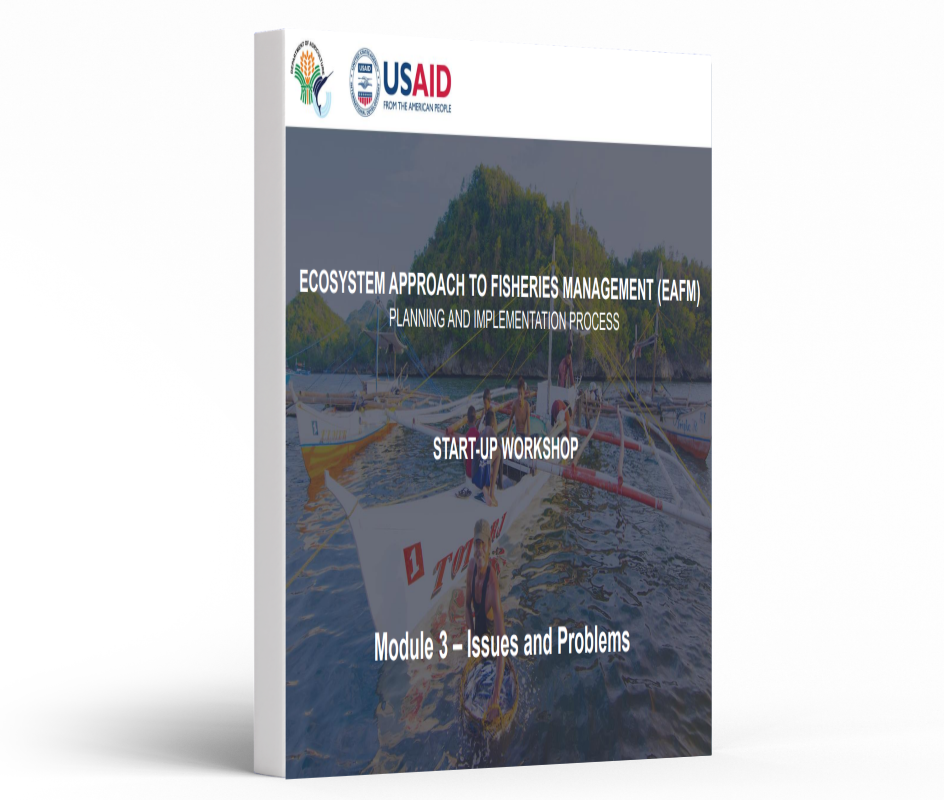
Ecosystem Approach to Fisheries Management (EAFM) Planning and Implementation Process - Start-up Workshop, Module 3: Issues and Problems
CTC-CFF Thematic Alignment
- Ecosystems Approach to Fisheries Management (EAFM)
Geographic Scope
- Philippines
Content Language(s)
- English
Introduction/Context
Overview:
“Ecosystem Approach to Fisheries Management (EAFM) Planning and Implementation Process - Start-up Workshop, Module 3: Issues and Problems”, developed by the Bureau of Fisheries and Aquatic Resources (BFAR), Department of Agriculture, Philippines with support from USAID, adapted from the regional “Essential EAFM Training Course”. Its goal is to have stakeholders identify and discuss the issues and problems affecting fisheries and coastal resources management within their proposed fisheries managemement area (FMA).
Background:
Building on Module 2’s background briefing on the proposed FMA’s fisheries resources, socio-economics, and governance, this module has stakeholders reflect on how fisheries resources and habitats have changed over roughly the last 20 years, why fisheries matter to community livelihood, food security, and the local economy, and how those changes have affected both the resources and the people who depend on them.
Problem Statement:
Without a structured process to surface issues and problems directly from stakeholders, EAFM planning risks being driven by assumptions rather than local knowledge, and can miss cross-boundary issues where an activity in one LGU affects fisheries and habitats in another. This module addresses that gap by systematically eliciting and documenting isues before mo ving into later planning steps such as threat prioritization.
Specific Location
Philippines; applied to the proposed fisheries management area (FMA) identified and validated in Module 2, which spans the municipal waters of multiple LGUs
Geographical Detail
Applicable to Philippine coastal and marine fisheries management areas experiencing resource decline, habitat degradation, or use conflicts; the guiding questions and card-based activity are generic and intended for use in any FMA.
Scale
Sub-national, fisheries-management-area scale, explicitly framed to surface issues that cross LGU and inter-agency boundaries within the proposed FMA.
Structure:
• Present the objectives: identify and discuss issues and problems on fisheries and coastal resources management in the proposed FMA
• Pose guiding questions on how fisheries resources and habitats have changed over roughly the last 20 years
• Discuss the importance of fisheries to community livelihood, food security, and the local economy, and how observed changes have affected fisheries and people
• Facilitate Activity 3: have participants individually list specific issues and problems affecting fisheries and associated ecosystems, one per card, covering the entire area or their own LGU
• Collect the cards and close with key messages on the breadth of issues, their cross-boundary nature, and the value of inter-LGU/inter-agency cooperation
Success factors:
• Using individuals cards for each issue (rather than open group discussion alone) let quieter participants and minority viewpoints surface issues without being drowned out
• Framing questions around a 20-year time horizon and livelihood/food security stakes made and abstract “list your issues” prompt concrete and personally relevant
• Explicitly naming cross-boundary and inter-agency dynamics primed participants for the cooperation needed in later planning and management steps
Critical challenges::
Surfacing the full breadth of fisheries and coastal resource issues -- including those that cross LGU boundaries -- from a mixed group of stakeholders without the discussion being dominated by the most vocal participants or a single agency’s priorities.
The Breakthrough::
Shifting from open discussion to an individual, card-based listing exercise (Activity 3) meant every participants issues were captured and submitted to the facilitator, surfacing a fuller and more representative picture of problems than group discussion alone.
Success factors::
A card-based, one-issue-per-card brainstorming format that captures input from every participant; guiding questions framed around a concrete 20-year time horizon and livelihood/food-security stakes; and explicit key messages naming cross-boundary issues and the need for inter-LGU/inter-agency cooperation.
Result snapshots::
Not specified in the source training materials -- the submitting organization should provide the actual list of issues and problems identified for the FMA, if available
Transferable tips::
• Use an individual, one-item-per-card format for issue identification so quieter participants and minority viewpoints arent drowned out by group discussion
• Frame guding questions around a concrete time horizon (e.g., changes over the last 20 years) and livelihood/food-security stakes to make exercise personally relevant.
• Explicitly name cross-boundary and inter-agency dynamics as a key message, since fisheries issues rarely respect a single LGUs jurisdiction.
Institution:
Bureau of Fisheries and Aquatic Resources (BFAR)
email : info@bfar.da.gov.ph
website : bfar.da.gov.ph