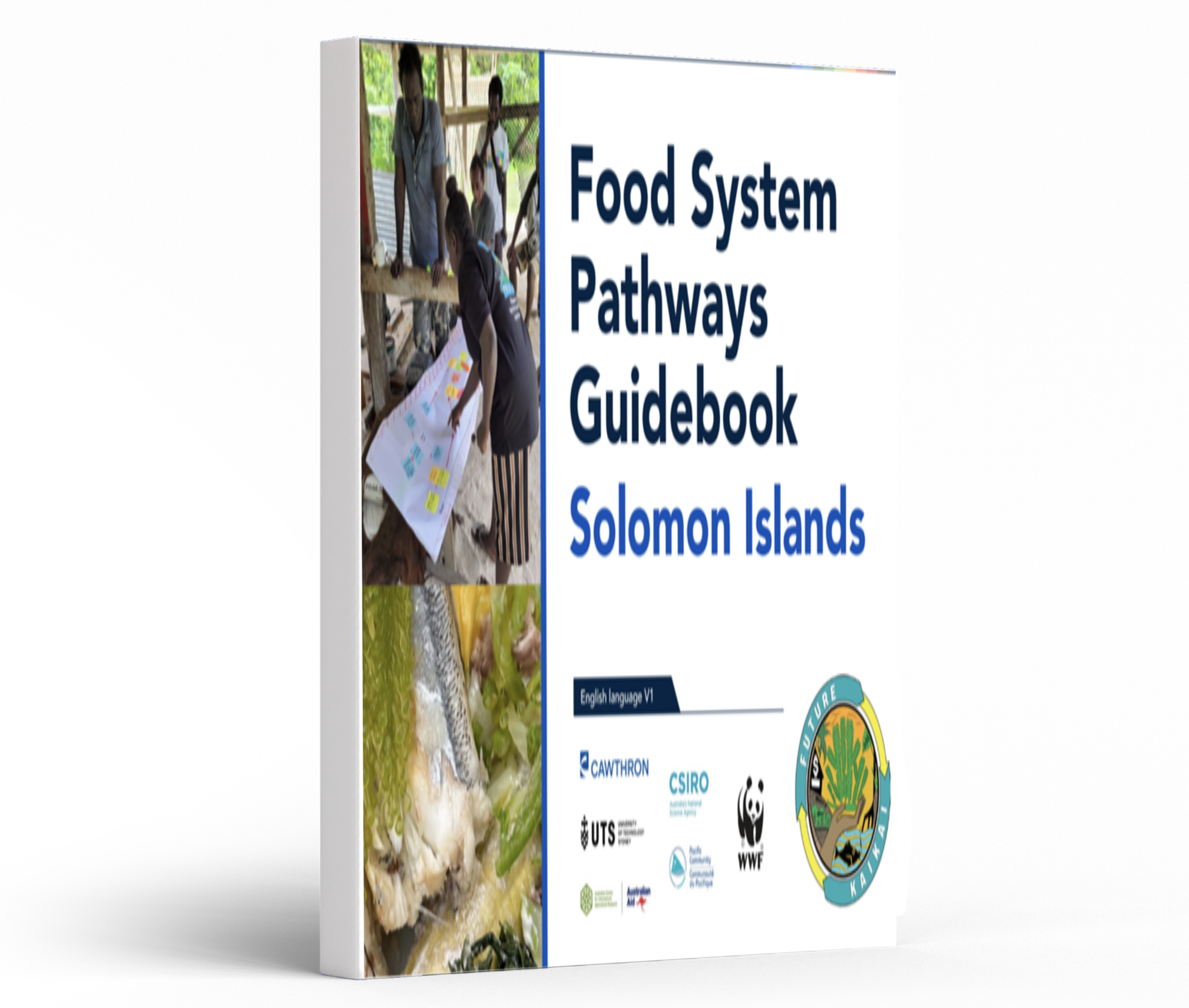
The Food System Pathways Guidebook - Solomon Islands
CTC-CFF Thematic Alignment
- Climate change
- Gender Equality and Social Inclusion (GESI)
- Ecosystems Approach to Fisheries Management (EAFM)
Geographic Scope
- Solomon Islands
Content Language(s)
- English
Introduction/Context
Overview:
The Food System Pathways Guidebook - Solomon Islands was developed through the ACIAR-funded Transformation Pathways for Pacific Coastal Food Systems project to support communities, facilitators, and knowledge brokers in understanding food systems, anticipating future uncertainty, and developing adaptation pathways for resilient and sustainable food systems. The Guidebook uses participatory tools and visual learning approaches to strengthen community planning and decision-making.
Background:
Communities in Solomon Islands face increasing pressures from climate change, sea level rise, population growth, natural disasters, economic changes, shifting diets, and technological change. These pressures threaten food security, livelihoods, governance systems, ecosystem health, and long-term resilience. Traditional planning approaches ofren struggle to address uncertainty and interconnected food system challenges.
Problem statement:
There is a need for practical and participatory planning tols that help communities understand their food systems, identify drivers of change, assess future risks, and develop adaptation pathways that strengthen resilience, governance, food security, and sustainable livelihoods. The guidebook was developed to support community-led planning and adaptive decision-making under conditions of uncertainty.
Specific location
Solomon Islands, including pilot communities in Western Province such as Sairagi Village and the Ijo Maringi Association in Gizo Island.
Geographical detail
Coastal and island food systems dependent on fisheries, agriculture, markets, natural resources, governance systems, and marine ecosystems.
Scale
Community and provincial-level participatory planning processes applicable across Pacific Island and Coral Triangle food systems.
Structure:
To transform local food systems, the process begins by assessing food systems characteristics, where communities map out production, harvests, diets, markets, and waste using the Food System Wheel to pinpoint key items, challenges, and local responses. Next, participants analyze historical changes and governance systems, exploring past shifts while identifying the decision-makers and power relations that influence system choices. This leads into identifying root causes and food system problems through causal loop analysis to uncover underlying triggers and feedback loops.
To narrow their focus, stakeholders identify major drivers of change—such as climate, socioeconomic shifts, and disasters—before voting to prioritize the most critical forces. Using the two highest-priority drivers, groups explore future scenarios and risks, mapping out low to high-risk futures to navigate uncertainty. With these scenarios in mind, participants develop a shared food system vision rooted in whole-system thinking to guarantee long-term security.
To turn this vision into reality, communities identify adaptation solutions and risks, prioritizing flexible, "no-regrets" actions. Groups then design adaptation pathways by carefully sequencing actions, decision points, responsibilities, and timing. Finally, the framework works to strengthen stakeholder participation and governance, fostering active collaboration among communities, government agencies, NGOs, and experts. This ensures stakeholders can successfully implement, monitor, and refine pathways over time through strategic pilot projects and adaptive management.
To narrow their focus, stakeholders identify major drivers of change—such as climate, socioeconomic shifts, and disasters—before voting to prioritize the most critical forces. Using the two highest-priority drivers, groups explore future scenarios and risks, mapping out low to high-risk futures to navigate uncertainty. With these scenarios in mind, participants develop a shared food system vision rooted in whole-system thinking to guarantee long-term security.
To turn this vision into reality, communities identify adaptation solutions and risks, prioritizing flexible, "no-regrets" actions. Groups then design adaptation pathways by carefully sequencing actions, decision points, responsibilities, and timing. Finally, the framework works to strengthen stakeholder participation and governance, fostering active collaboration among communities, government agencies, NGOs, and experts. This ensures stakeholders can successfully implement, monitor, and refine pathways over time through strategic pilot projects and adaptive management.
Success factors:
Strong community participation and ownership
Visual and interactive learning approaches
Integration of local knowledge and scientific/ecternal knowledge
Practical and adaptable planning tools
Multi-stakeholder collaboration and knowledge exchange
Clear link between food system analysis, future scenarios, solutions, and action pathways
Visual and interactive learning approaches
Integration of local knowledge and scientific/ecternal knowledge
Practical and adaptable planning tools
Multi-stakeholder collaboration and knowledge exchange
Clear link between food system analysis, future scenarios, solutions, and action pathways
Critical challenges:
Addressing future uncertainty, climate risks, governance complexity, and balancing diverse stakeholder priorities within foor system planning.
The Breakthrough:
The use of participatory visual tools and scenario-based adaptation pathways enabled communities to better understand uncertainty and collaboratively plan for resilient food system futures.
Success factors:
Community-led facilitation approaches
Integration of local and external knowledge
Strong visual and participatory learning methods
Flexible and adaptive planning tools
Multi-stakeholder engagement and dialogue
Result snapshots:
Improved understanding of food systems, future risks, adaptation options, governance structures, and implementation pathways among participating communities and facilitators.
Transferable tips:
Use visual tools to simplify complex food system relationships
Integrate local knowledge with climate, population, diet, and market information
Focus on flexible, low-risk, and no-regrets adaptation actions
Identify responsible actors and decision points for each pathway
Repeat planning exercises as conditions change
Addressing future uncertainty, climate risks, governance complexity, and balancing diverse stakeholder priorities within foor system planning.
The Breakthrough:
The use of participatory visual tools and scenario-based adaptation pathways enabled communities to better understand uncertainty and collaboratively plan for resilient food system futures.
Success factors:
Community-led facilitation approaches
Integration of local and external knowledge
Strong visual and participatory learning methods
Flexible and adaptive planning tools
Multi-stakeholder engagement and dialogue
Result snapshots:
Improved understanding of food systems, future risks, adaptation options, governance structures, and implementation pathways among participating communities and facilitators.
Transferable tips:
Use visual tools to simplify complex food system relationships
Integrate local knowledge with climate, population, diet, and market information
Focus on flexible, low-risk, and no-regrets adaptation actions
Identify responsible actors and decision points for each pathway
Repeat planning exercises as conditions change
Institution:

World Wildlife Fund (WWF)
email : info@wwf.org
website : wwf.org/