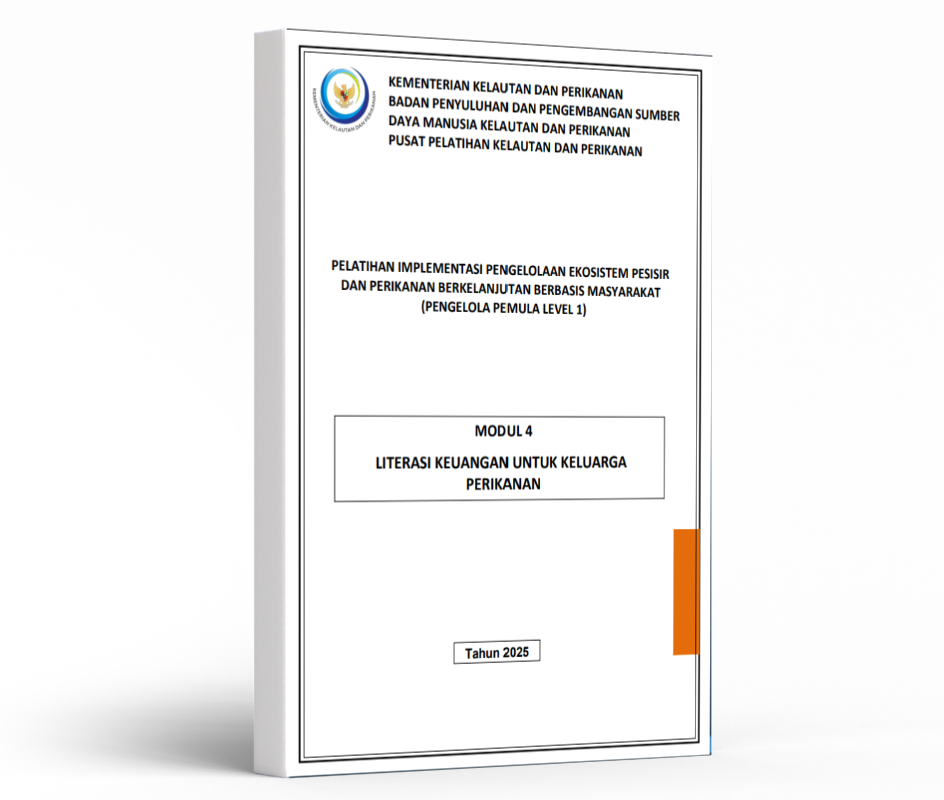
Modul Pelatihan: Literasi Keuangan untuk Keluarga Perikanan
CTC-CFF Thematic Alignment
- Community-Based Coastal Resource Management (CBCRM)
- Gender Equality and Social Inclusion (GESI)
Geographic Scope
- Indonesia
Content Language(s)
- Bahasa Indonesia
Introduction/Context
Overview:
The Financial Literacy for Fisheries Households training module was developed as part of the Community-Based Sustainable Coastal Ecosystem and Fisheries Management (PEP-PBBM) training program. The module aims to strengthen the financial management capacity of small-scale fisheries households, enabling them to make informed financial decisions, improve household resilience, and support sustainable fisheries management. Financial literacy is positioned not only as a household welfare tool but also as a critical component in reducing economic vulnerability that can drive unsustainable fishing practices.
Background:
Many small-scale fisheries households experience fluctuating incomes due to seasonality, weather conditions, and market uncertainties. Limited access to financial services and low financial literacy often result in poor financial planning, reliance on informal loans, and increased economic vulnerability.
The module introduces key financial literacy concepts, inclusive financial participation, household income diversification, expenditure prioritization, and simple household profit-loss calculations. Participants learn practical approaches to recording income and expenses, assessing financial conditions, and planning for future needs.
The module introduces key financial literacy concepts, inclusive financial participation, household income diversification, expenditure prioritization, and simple household profit-loss calculations. Participants learn practical approaches to recording income and expenses, assessing financial conditions, and planning for future needs.
Problem Statement:
Low financial literacy among fisheries communities limits their ability to manage household finances, access formal financial services, build savings, and diversify income sources. This economic vulnerability may contribute to overfishing, illegal fishing practices, and reduced capacity to participate in sustainable fisheries management initiatives.
Specific Location
Applicable to coastal and fisheries-dependent communities throughout Indonesia and other Coral Triangle countries implementing community-based fisheries management programs.
Geographical Detail
Coastal villages, small islands, and fisheries-dependent communities where livelihoods rely on small-scale fisheries, fish processing, fish trading, and related marine-based enterprises.
Scale
Household and community level, targeting fisheries households, women fisher
Structure:
Structure:
Step 1. Stakeholder Identification
Identify fisheries households, fishers, women involved in post-harvest activities, fish traders, youth groups, vulnerable community members, and local facilitators. Ensure representation from various social and economic groups.
Step 2. Stakeholder Engagement
Conduct introductory discussions explaining the link between household economic resilience, financial literacy, and sustainable fisheries management. Facilitate
inclusive participation using GESI principles.
Step 3. Financial Literacy Awareness
Introduce the concept of financial literacy, its importance, relevant policies, financial institutions, and financial products. Participants assess their own financial literacy levels based on OJK classifications.
Step 4. Promoting Inclusive Participation
Facilitate discussions and exercises that involve women, youth, and vulnerable
groups in financial planning and fisheries management activities. Encourage equal opportunities for participation and decision-making.
Step 5. Household Income Assessment
Guide participants to identify all household income sources, including fisheries and
non-fisheries activities. Convert income streams into weekly values and calculate total household income.
Step 6. Household Expenditure Assessment
Assist participants in classifying expenditures into priority and non-priority categories. Record and calculate weekly household expenditures to identify spending patterns.
Step 7. Financial Analysis
Participants calculate household profit or loss by comparing total income and
expenditures. Reflection exercises help identify opportunities for improving financial management.
Step 8. Financial Planning and Resilience Building
Facilitate discussions on savings, income diversification, risk management, responsible borrowing, and accessing formal financial services to strengthen household resilience.
Success factors:
• Strong community participation.
• Inclusive involvement of women, youth, and vulnerable groups.
• Practical and hands-on exercises using real household financial data.
• Linkage between financial literacy and sustainable fisheries management.
• Use of simple tools that can be replicated independently by participants.
• Inclusive involvement of women, youth, and vulnerable groups.
• Practical and hands-on exercises using real household financial data.
• Linkage between financial literacy and sustainable fisheries management.
• Use of simple tools that can be replicated independently by participants.
Critical challenges::
• Low levels of financial literacy among fisheries households.
• Limited access to formal financial institutions and services in remote coastal areas.
• Highly variable and seasonal household incomes.
The Breakthrough::
The integration of financial literacy into community-based fisheries management demonstrated that household economic resilience and sustainable fisheries outcomes are mutually reinforcing. Improving household financial management reduced vulnerability and supported more responsible resource use.
Success factors::
• Application of GESI principles.
• Active participation of women in household financial management.
• Practical financial recording and calculation exercises.
• Recognition of diverse household income sources.
• Continuous learning and reflection.
Result snapshots::
• Increased awareness of household financial conditions.
• Improved ability to track income and expenditures.
• Better understanding of savings and financial planning.
• Enhanced participation of women and youth in financial decision-making.
• Stronger economic resilience to support sustainable fisheries practices.
Transferable tips::
? Practical Tip #1: Use actual household income and expenditure data during training exercises.
? Practical Tip #2: Involve both husbands and wives in financial literacy sessions.
? Practical Tip #3: Link financial planning discussions with fisheries sustainability objectives.
? Practical Tip #4: Ensure participation of youth and vulnerable groups.
? Practical Tip #5: Start with simple weekly financial calculations before introducing more advanced concepts.
Institution:
Pusat Pelatihan Kelautan dan Perikanan, Kementrian Kelautan dan Perikanan
email : -
website : elaut-bppsdm.kkp.go.id/

Rare
email : indonesia@rare.org
website : rare.org/region/asia-pacific/indonesia/