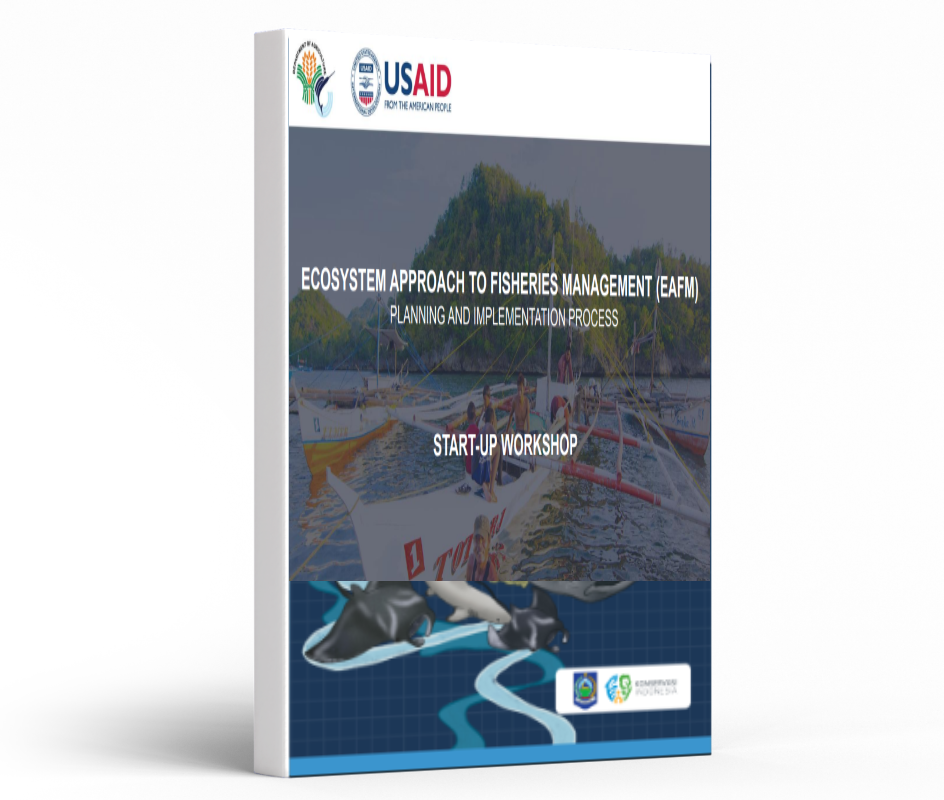
Ecosystem Approach to Fisheries Management (EAFM) Planning and Implementation Process - Start-up Workshop, Module 1: Introduction
CTC-CFF Thematic Alignment
- Ecosystems Approach to Fisheries Management (EAFM)
Geographic Scope
Content Language(s)
Introduction/Context
Overview:
This module developed by the Bureau of Fisheries and Aquatic Resources (BFAR), Department of Agriculture, Philippines, with support from USAID, adapted from the regional “Essential EAFM Training Course”. Its goal is to mainstream EAFM as provided under the amended Philippine Fisheries Code and to prepare stakeholders to launch the EAFM planning process for their fisheries management area (FMA).
Background:
BFAR facilitates preparation of EAFM Plans for identified fisheries management areas (FMAs) together with LGUs and other stakeholders; LGUs then adopt the EAFM Plan and translate management actions into local ordinances and policies, while BFAR aligns national programs to the plan. This Start-up Workshop module was adapted from the internationally used Essential EAFM Training Course (developed by APFIC, the Bay of Bengal Large Marine Ecosystem Project, the Coral Triangle Initiative, FAO, IMA International, and NOAA) to build this capacity in the Philippines
Specific Location
Philippines (national in scope), applied at the level of individual fisheries management areas (FMAs) that typically span the municipal waters of multiple local government units (LGUs).
Geographical Detail
Applicable to Philippine municipal and FMA-level marine and coastal waters where jurisdiction is shared across multiple LGUs and national agencies; the start-up process is generic and intended for use in any FMA prior to detailed EAFM planning.
Scale
Sub-national, fisheries-management-area scale -- typically spanning the municipal waters of severa; LGUs -- within a national BFAR program to mainstream EAFM across the Philippines.
Structure:
? Identify the fisheries management area (FMA)
? Coordinate with other agencies and LGUs, and determine the legal basis for EAFM
? Formalize and EAFM team and facilitators
? Identify stakeholders and develop a start-up workplan
? Introduce EAFM to the identified stakeholders prior to the planning process
? Coordinate with other agencies and LGUs, and determine the legal basis for EAFM
? Formalize and EAFM team and facilitators
? Identify stakeholders and develop a start-up workplan
? Introduce EAFM to the identified stakeholders prior to the planning process
Success factors:
? Grounding the workshop in the amended Philippine Fisheries Code gave EAFM a clear legal basis from the outset
? An early stakeholder reflection activity surfaced expectations and buy-in before technical content began
? A clear, sequenced checklist of start-up tasks gave facilitators an actionable launch sequence for a new FMA
? An early stakeholder reflection activity surfaced expectations and buy-in before technical content began
? A clear, sequenced checklist of start-up tasks gave facilitators an actionable launch sequence for a new FMA
Critical challenges::
Coordinating across the multiple LGUs and national agencies that share jurisdiction over a single fisheries management area, and building a shared understanding of an ecosystem-based (rather than single-species or single-sector) approach among diverse stakeholders from the very start.
The Breakthrough::
Opening with a structured reflection activity on “hopes, concerns, and what we bring to the process” -- before introducing technical EAFM content -- helped surface stakeholder expectations and align the group around a shared starting point.
Success factors::
Clear legal grounding in the amended Fisheries Code; a concrete, sequenced seven-task start-up checklist; an early stakeholder reflection activity; and adaptation of an internationally tested regional training course (Essential EAFM) to the Philippine legal and institutional context
Result snapshots::
Not specified in the source training materials -- the submitting organization should provide actual workshop rollout data (e.g., number of FMAs and stakeholders reached) if available.
Transferable tips::
? Establish the legal basis for the ecosystem approach early so stakeholders understand the mandate, not just the process
? Use a structured, numbered checklist of start-up tasks to give facilitators a clear, replicable launch sequence for a new planning area
? Open with a reflection activity on hopes and concerns to surface expectations before introducing technical content
Institution:
Bureau of Fisheries and Aquatic Resources (BFAR)
email : info@bfar.da.gov.ph
website : bfar.da.gov.ph