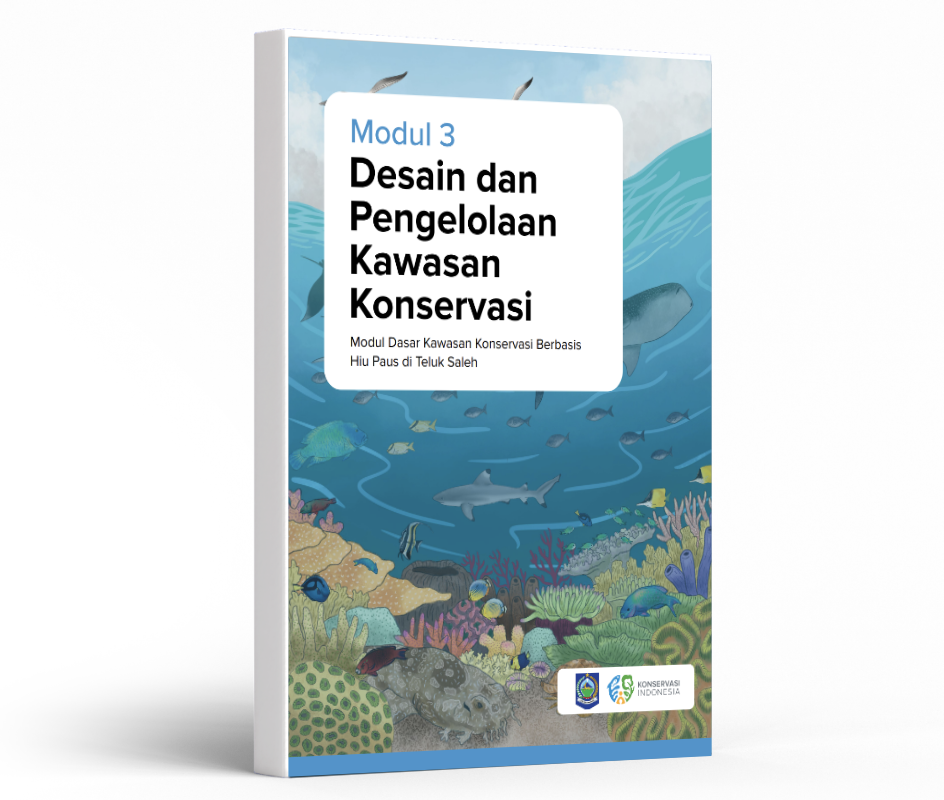
Module 3: Design and Management of Conservation Areas
CTC-CFF Thematic Alignment
- Threatened Species
- Marine Protected Area (MPA)
- Marine Spatial Planning (MS)
Geographic Scope
- Indonesia
Content Language(s)
- Bahasa Indonesia
Introduction/Context
Overview:
This module is an educational guidebook published by Konservasi Indonesia that focuses on the principles of planning, designing, and effectively managing Marine Protected Areas (MPAs), specifically within the context of whale shark conservation in Saleh Bay. The module outlines critical design elements such as location selection, spatial scaling, connectivity, and Indonesia's zoning system under PERMEN KP No. 31/2020, which balances strict ecological protection in core zones with sustainable socio-economic uses like community fisheries and ecotourism. By outlining strategic management tools—including gear, temporal, and quota regulations—and emphasizing the absolute necessity of multi-stakeholder collaboration, this resource serves as a practical framework for achieving long-term marine biodiversity preservation and fostering sustainable coastal livelihoods
Background:
Marine ecosystems are increasingly threatened by habitat degradation, overexplanation, pollution, and climate change. Conservation areas, or Marine Protected Areas (MPAs), are an important strategy to protect biodiversity, critical habitats, and ecosystem services. However, conservation areas cannot achieve their objectives simply by being established; they must also be designed and managed effectively.
The module explains the legal framework, zoning systems, ecological connectivity, stakeholder engagement, and management strategies required for effective conservation area governance.
Problem statement:
Many conservation areas face challenges due to unclear objectives, weak management systems, poor stakeholder engagement, and ineffective zoning. This module addresses these gaps by providing practical guidance on conservation area design and management.
Specific location
Teluk Saleh, Sumbawa, West Nusa Tenggara, Indonesia
Geographical detail
Coastal and marine ecosystems including coral reefs, mangroves, seagrass beds, and pelagic habitats important for whale sharks and marine biodiversity.
Scale
Training module designed for site-level implementation with applicability across marine conservation areas in the Coral Triangle region.
Structure:
1. Introduce conservation area concepts and objectives
Explain the purpose, benefits, and legal framework of conservation areas, including biodiversity protection and sustainable resource use.
2. Define conservation goals and targets
Identify conservation objectives and develop SMART targets based on ecological and socio-economic priorities.
3. Design conservation areas
Develop conservation area design considering location, size, shape, connectivity, and management practicality.
4. Establish zoning systems
Define core zones, sustainable use zones, and supporting zones to balance protection and utilization.
5. Regulate resource use and activities
Develop rules for fisheries, tourism, research, transportation and other activities to minimize impacts.
6. Engage stakeholders
Involve local communities, government, researchers, tourism operators, and other stakeholders in planning and management.
7. Apply interactive planning exercises
Use participatory mapping and simulation exercises to strengthen understanding and decision-making.
8. Evaluate and adapt management
Assess management effectiveness and adapt strategies based on ecological and social outcomes.
Explain the purpose, benefits, and legal framework of conservation areas, including biodiversity protection and sustainable resource use.
2. Define conservation goals and targets
Identify conservation objectives and develop SMART targets based on ecological and socio-economic priorities.
3. Design conservation areas
Develop conservation area design considering location, size, shape, connectivity, and management practicality.
4. Establish zoning systems
Define core zones, sustainable use zones, and supporting zones to balance protection and utilization.
5. Regulate resource use and activities
Develop rules for fisheries, tourism, research, transportation and other activities to minimize impacts.
6. Engage stakeholders
Involve local communities, government, researchers, tourism operators, and other stakeholders in planning and management.
7. Apply interactive planning exercises
Use participatory mapping and simulation exercises to strengthen understanding and decision-making.
8. Evaluate and adapt management
Assess management effectiveness and adapt strategies based on ecological and social outcomes.
Success factors:
1. Strong integration of ecological and social considerations
2. Clear zoning and management structure
3. Stakeholder participation
4. Practical and interactive learning methods
5. Use of real-world case studies
2. Clear zoning and management structure
3. Stakeholder participation
4. Practical and interactive learning methods
5. Use of real-world case studies
Critical challenges:
Balancing conservation objectives with fisheries, tourism, and local livelihoods
The Breakthrough:
Participatory planning and zoning approaches improved stakeholder support and management understanding
Success factors:
1. Strong legal framework
2. Community engagement
3. Science-based planning
4. Clear zoning systems
5. Practical learning approach
Result snapshots:
Improved participant understanding of conservation area planning and management principles
Transferable tips:
1. Start with clear conservation goals
2. Engage stakeholders early
3. Use participatory mapping
4. Combine ecological and socio-economic data
5. Apply adaptive management principles
Balancing conservation objectives with fisheries, tourism, and local livelihoods
The Breakthrough:
Participatory planning and zoning approaches improved stakeholder support and management understanding
Success factors:
1. Strong legal framework
2. Community engagement
3. Science-based planning
4. Clear zoning systems
5. Practical learning approach
Result snapshots:
Improved participant understanding of conservation area planning and management principles
Transferable tips:
1. Start with clear conservation goals
2. Engage stakeholders early
3. Use participatory mapping
4. Combine ecological and socio-economic data
5. Apply adaptive management principles
Institution:
Konservasi Indonesia
email : -
website : konservasi-id.org/