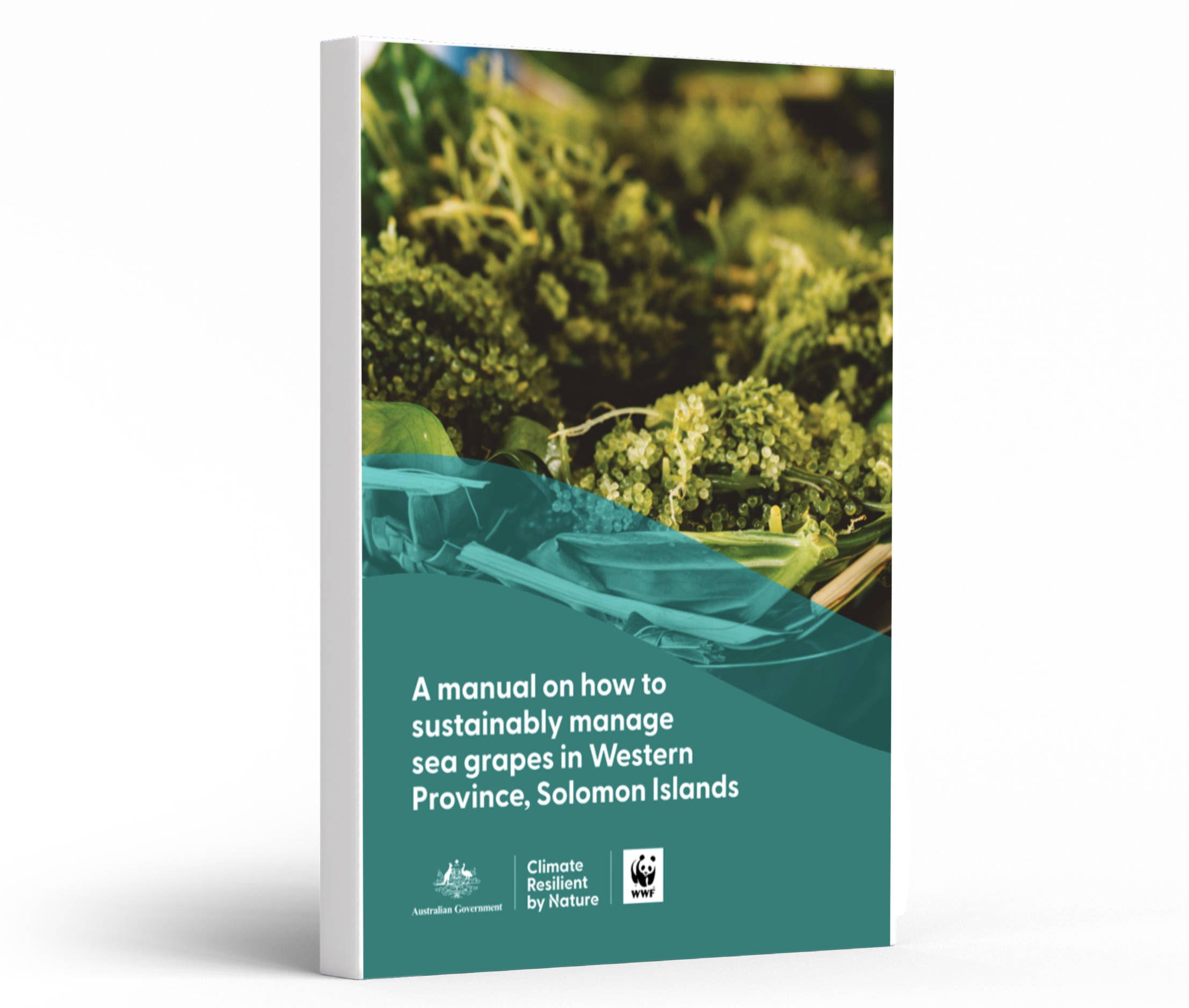
A manual on how to sustainably manage sea grapes in Western Province, Solomon Islands
CTC-CFF Thematic Alignment
- Ecosystems Approach to Fisheries Management (EAFM)
- Gender Equality and Social Inclusion (GESI)
- Marine Protected Area (MPA)
- Climate change
Geographic Scope
- Solomon Islands
Content Language(s)
- English
Introduction/Context
Overview:
“A Manual on How to Sustainably Manage Sea Grapes in Western Province, Solomon Islands” was developed by WWF-Pacific Solomon Islands to support coastal communities in sustainably managing sea grape resources while strengthening livelihoods, food security, marine conservation, and climate resilience.
Background:
Sea Grapes are an important food and income source for coastal communities in Western Province, particularly for women harvesters. Communities including Sairagi, Boboe, Pusiju, and Kongulavata rely heavily on sea grape harvesting and sales for household incone, school fees, and food security. However, overharvesting, mangrove cutting, reef degradation, sedimentation, and climate variability have negatively impacted sea grape abundance and ecosystem health.
Problem statement:
Declining sea grape abundance threathened marine ecosystems, food security, women’s livelihoods and long-term resilience. Communities required practical guidance on sustainable harvesting, ecosystem protection, monitoring, climate adaptation, and value-added livelihood development.
Specific location
Western Province, Solomon Islands including Sairagi, Boboe, Kongulavata, and Pusiju communities
Geographical detail
Coastal reef and mangrove ecosystems where sea grapes naturally grow.
Scale
Approximately 406 hectares of marine ecosystem under improved management.
Structure:
To advance sea grape conservation, initiatives first built robust community awareness, introducing local populations to the ecological, nutritional, and livelihood importance of sea grapes, mangroves, and healthy marine ecosystems. This foundation enabled stakeholders to establish community management structures by forming Management Committees, nominating Community Facilitators, and appointing Community Rangers. Working together, they developed community-based management plans with shared visions, clear zoning, and customized harvesting rules.
Central to these plans was the implementation of sustainable harvesting practices; women harvesters adopted precise pruning techniques—harvesting only shoots instead of uprooting whole plants—to allow faster regrowth. To prevent overexploitation, communities introduced harvesting limits and closure systems, enforcing basket limits and temporary closures. Simultaneously, they strengthened ecosystem protection measures by restricting mangrove cutting, pollution, and reef damage. To track progress, Community Rangers conducted regular biological and community monitoring using transects and quadrats to guide management decisions.
On the economic side, communities improved post-harvest handling and market systems, refining cleaning, packaging, and transport to maximize freshness and market value. This commercial optimization promoted women-led livelihoods and savings systems, boosting household income while fostering long-term financial security through savings clubs. Finally, communities developed value-added sea grape products like soaps and lotions, effectively diversifying local livelihoods and reducing harvesting pressure during critical closure periods.
Central to these plans was the implementation of sustainable harvesting practices; women harvesters adopted precise pruning techniques—harvesting only shoots instead of uprooting whole plants—to allow faster regrowth. To prevent overexploitation, communities introduced harvesting limits and closure systems, enforcing basket limits and temporary closures. Simultaneously, they strengthened ecosystem protection measures by restricting mangrove cutting, pollution, and reef damage. To track progress, Community Rangers conducted regular biological and community monitoring using transects and quadrats to guide management decisions.
On the economic side, communities improved post-harvest handling and market systems, refining cleaning, packaging, and transport to maximize freshness and market value. This commercial optimization promoted women-led livelihoods and savings systems, boosting household income while fostering long-term financial security through savings clubs. Finally, communities developed value-added sea grape products like soaps and lotions, effectively diversifying local livelihoods and reducing harvesting pressure during critical closure periods.
Success factors:
Strong community ownership
Integration of traditional knowledge and scientific monitoring
Women-led livelihood systems
Clear management rules
Community Ranger monitoring systems
Integration of traditional knowledge and scientific monitoring
Women-led livelihood systems
Clear management rules
Community Ranger monitoring systems
Critical challenges:
Overharvesting, climate variability, habitat degradation, and ensuring compliance with management rules.
The Breakthrough:
Communities combined traditional ecological knowledge with scientific monitoring and adaptive management approaches
Success factors:
Strong women-led participation
Community ownership
Adaptive management using monitoring data
Integration of conservation and livelihoods
Result snapshots:
Sea grape abundance improved, women’s livelihoods strengthened, and communities developed new value-added products.
Transferable tips:
Avoid uprooting entire sea grape plants
Use temporary harvest closures when needed
Combine traditional knowledge with scientific monitoring
Strengthen women’s leadership
Overharvesting, climate variability, habitat degradation, and ensuring compliance with management rules.
The Breakthrough:
Communities combined traditional ecological knowledge with scientific monitoring and adaptive management approaches
Success factors:
Strong women-led participation
Community ownership
Adaptive management using monitoring data
Integration of conservation and livelihoods
Result snapshots:
Sea grape abundance improved, women’s livelihoods strengthened, and communities developed new value-added products.
Transferable tips:
Avoid uprooting entire sea grape plants
Use temporary harvest closures when needed
Combine traditional knowledge with scientific monitoring
Strengthen women’s leadership
Institution:
World Wildlife Fund (WWF)
email : info@wwf.org
website : wwf.org/
Contact Person:

Sally Yacoub
-
Expert Profile Overview: Sally Yacoub is a Senior Gender Equality and Social Inclusion (GESI) expert and trainer with over 23 years of experience, including direct work with the Coral Triangle Center ...

Ria Fitriana, PhD.
Indonesia
Expert Profile Overview: She has extensive knowledge on socio economic coastal villagers, value chain analysis of marine products, marine products development and livelihoods of small scale fishers. ...